Where Will US Drug Strikes Move Next After 200 Deaths at Sea?
More than 200 people have died in over 60 boat strikes. Pete Hegseth now says Washington will seek the same effect on land, with partners signed up.
Commentary & Analysis ·
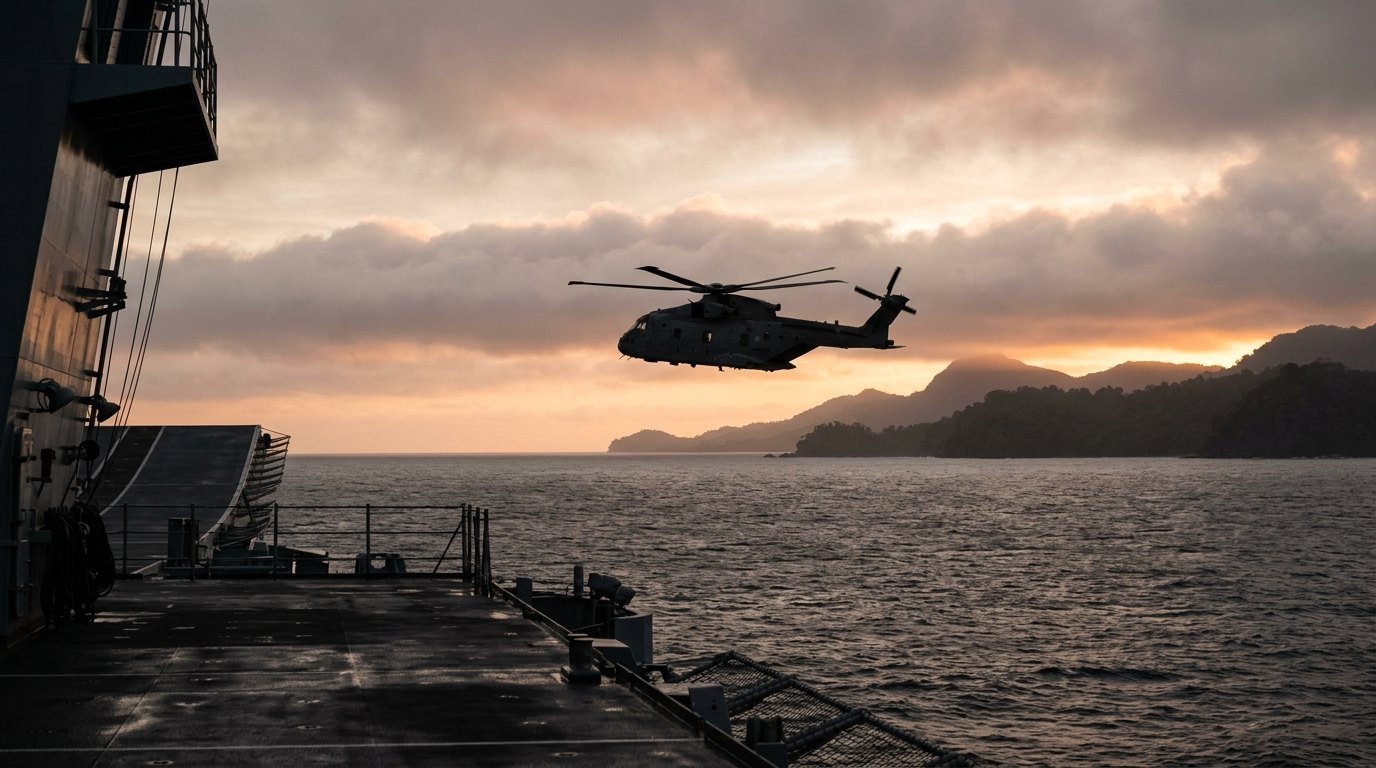
For a year the US has been striking small boats it says carry drugs, killing more than 200 people in over 60 strikes. Pete Hegseth now says Washington wants the same effect on land. Here's which governments have signed up, which one denies it, and why a strike inside a sovereign country raises questions the sea strikes never had to answer.
Verified key facts
- More than 200 people have been killed in over 60 strikes on boats in the Caribbean and eastern Pacific in the past year, according to the Associated Press.
- Defence Secretary Pete Hegseth announced the land expansion during a visit to Panama on 12-13 August, the Associated Press reported.
- Hegseth said Colombia, Guatemala and Honduras had agreed to joint operations on their soil, following Ecuador, which began in March 2025.
- Guatemalan President Bernardo Arevalo denied that his government had reached such an agreement, per the Associated Press.
- Britannica's running tally recorded at least 26 boat strikes and at least 95 deaths by the end of November 2025.
- Mexican President Claudia Sheinbaum has resisted a US military role against cartels on Mexican soil, the Associated Press reported.
From the Water to the Shore
For a year the United States has been bombing small boats it accuses of carrying drugs off Latin America's Caribbean and Pacific coasts. The Associated Press reports that more than 200 people have been killed in over 60 such strikes. Britannica's running tally of the campaign recorded at least 26 operations and at least 95 deaths by the end of November 2025, which gives a sense of how sharply the tempo has risen since.
The Trump administration has now said it intends to take the campaign ashore. That is a change of kind rather than of degree: a strike on a vessel in international waters and a strike on a target inside a sovereign state raise entirely different legal and diplomatic questions.
The campaign began in September 2025 and has escalated steadily since. Each strike destroys a small vessel and everyone aboard it, and the administration has released little identifying information about those killed, which has left the casualty figures to be assembled by news organisations and outside trackers rather than published officially.
What Hegseth Said in Panama
Defence Secretary Pete Hegseth set out the policy during a visit to Panama on 12 and 13 August. He told reporters the aim was the "same effect on land", adding that Washington was "working with Ecuador" and other partners "to bring the fight to the [designated terrorist organizations] on land", according to the Associated Press.
He framed the targeting standard broadly. "Anywhere you traffic drugs or you threaten the American people," Hegseth said, "you are a target just like ISIS or al-Qaida." The comparison is deliberate: it borrows the legal architecture built after 2001 for a set of organisations that are criminal rather than jihadist.
Who Has Signed Up, and Who Denies It
Hegseth said Colombia, Guatemala and Honduras had agreed to allow joint military operations against criminal groups on their territory. Within a day that list was in dispute. Guatemalan President Bernardo Arevalo publicly denied reaching any such agreement, the Associated Press reported, leaving the administration's own account of its coalition contradicted by one of its named members.
Colombia is the clearest case. President Abelardo de la Espriella, who took office this month, has actively requested greater American military involvement, which makes Bogota the most likely site of the first land operations under the expanded policy.
Honduras occupies a middle position. Its inclusion on Hegseth's list has not been contradicted in the way Guatemala's was, but nor has it been confirmed with the detail that would establish what joint operations there would actually involve.
Ecuador Was the Template
Ecuador began joint missions with the United States in March 2025 and is the model the administration is now trying to replicate. Quito's cooperation was not uncontroversial at home: the country held a referendum in November 2025 on whether to permit foreign military bases, a vote that made the domestic politics of the arrangement explicit.
That referendum is instructive for the governments now being asked to follow. Consent given by a president is not the same as consent given by an electorate, and in several of the countries on Hegseth's list the two may not point the same way.
Mexico Remains the Hold-Out
Mexico is the largest source and transit point for fentanyl and other drugs entering the United States, and it is the country the campaign most obviously wants access to. President Claudia Sheinbaum has cooperated closely with Washington on security while refusing an American military role on Mexican soil, according to the Associated Press.
That position has held under sustained pressure. Sheinbaum's calculation is not hard to read: a foreign strike on Mexican territory would be a domestic political event of the first order, whatever its operational result.
Sheinbaum's government has instead expanded intelligence sharing, extraditions and joint enforcement against precursor chemicals, offering cooperation in every form short of allowing American forces to operate on Mexican soil. That distinction has become the central point of the bilateral relationship.
The Legal Question the Strikes Have Not Answered
The campaign's central unresolved issue is that lethal force is being applied to people who have not been charged, tried or, in most cases, identified. The administration's answer is the terrorist designation, which it argues moves the targets from a law-enforcement framework into an armed-conflict one.
That argument has not been tested in court. The Associated Press consulted regional specialists including Michael Shifter of the Inter-American Dialogue, William LeoGrande of American University, Jeremy McDermott of InSight Crime and Adam Isacson of the Washington Office on Latin America, a roster that reflects how contested the policy is among people who study the region professionally.
The Colombian Deployment That Will Test the Policy
Colombia is where the expanded campaign is most likely to be tried first, because it combines a president who has asked for the help with the infrastructure to host it. The first land strike inside a partner country will establish, in practice, what the administration means by consent and what it does when a host government's account diverges from its own.
Guatemala's denial has already shown how quickly that can happen. Until Washington and Guatemala City reconcile their versions, the size of the coalition Hegseth described in Panama remains an open question.
The wider risk the policy carries is that a strike inside a partner country kills people who were not the target. On the water, that consequence has been contested but contained; on land, in populated areas, it would be neither.
Sources
- Associated Press - After killing hundreds in boat strikes, US military expands campaign on land in Latin America
- Spectrum News - U.S. military expands campaign on land in Latin America
- Britannica - 2025 U.S. Strikes on Venezuelan Vessels
- Gulf News - Trump says US to launch land strikes against Mexico drug cartels
You may also like to read
Scott Bessent Promises the Toughest Sanctions in History as Washington Widens Operation Economic Fury Against Iran
The Treasury secretary told CNBC that companies trading with Tehran will face the full force of the United States, as the war nears its sixth month.
SLB and Hunt Oil Sign Venezuela's First US Production Deals of the Post-Maduro Era
Texas firms signed the first contracts with PDVSA since Maduro's capture, as Caracas courts Houston with fields it says are waiting to be discovered.
Trump Rules Out Extending the Iran Ceasefire as Tehran Signals a Fully Offensive Posture
The temporary truce has expired with no successor deal, and a senior Iranian official says Tehran will now shift to a fully offensive military footing.
Balochistan Insurgency Escalates With Attacks on Police, Soldiers and Transport Routes
Baloch insurgents killed abducted police and soldiers while Pakistani forces reported killing dozens of militants, in attacks and sweeps across the province.