Spain Declares National Emergency as Wildfires Spread Near Madrid
Spain declared a national emergency and deployed the army as wildfires near Madrid and Avila forced tens of thousands to flee or shelter.
Commentary & Analysis ·
Verified key facts
- Spain declared a national emergency over wildfires near Madrid and Avila on 24 July 2026.
- Euronews reported nearly 45,000 hectares scorched with about 90,000 people evacuated or confined.
- The government deployed thousands of personnel plus ground vehicles and aircraft.
- Greece, Italy and Portugal offered resources, Prime Minister Pedro Sanchez said.
- The fires formed part of a wider blaze across Spain and neighbouring France.
What happened
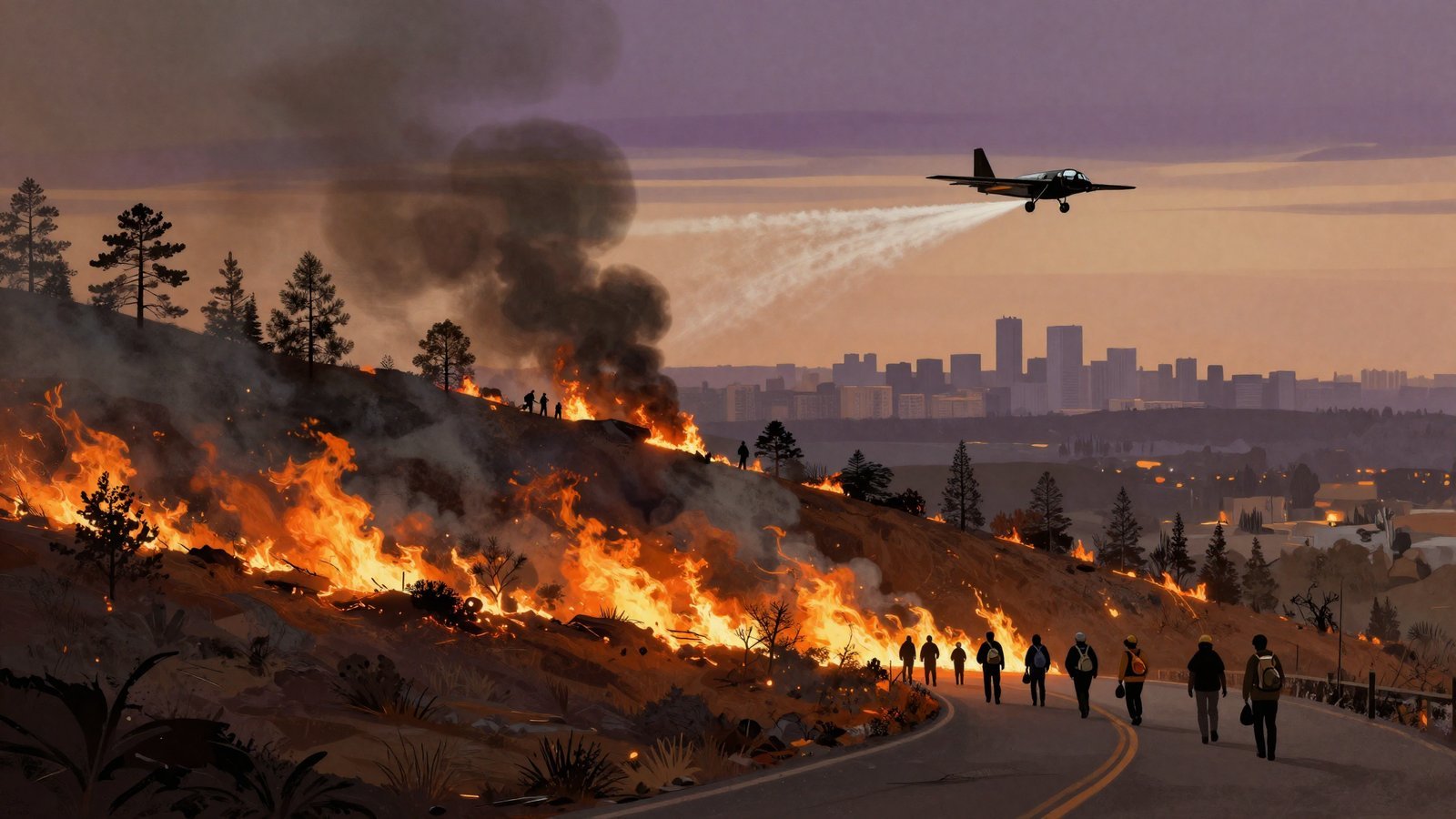
Spain declared a national emergency on 24 July and sent the military to help contain wildfires burning near Madrid and in the neighbouring province of Avila. Interior Minister Fernando Grande-Marlaska announced the measure as several major fires remained out of control.
Euronews reported that the fires had scorched nearly 45,000 hectares and forced around 90,000 people to evacuate or shelter in place. Bloomberg said blazes advanced to within roughly 50 kilometres of the capital, prompting a rapid scaling up of the response.
Authorities said thousands of firefighters and emergency personnel were deployed, supported by hundreds of ground vehicles and a fleet of water-dropping aircraft. Officials confined tens of thousands of residents indoors as smoke degraded air quality across central Spain.
Reporting described more than a dozen towns evacuated across Madrid and Avila as the fires jumped containment lines. Roads were closed and rail services disrupted in places, complicating both evacuations and the movement of firefighting resources.
A summer of extreme heat and fire
The emergency followed weeks of hot, dry conditions across southern Europe that primed forests and scrubland to ignite. Al Jazeera reported that fires in Spain and France together forced the evacuation of more than a quarter of a million people during the same period.
Scientists have repeatedly linked longer and more intense fire seasons in the Mediterranean to a warming climate, which dries vegetation and lengthens the window for dangerous blazes. Prolonged heatwaves compound the risk by exhausting firefighting crews.
Spain has endured several punishing summers in recent years, with fires destroying large areas of forest and farmland. Rural depopulation has left more unmanaged land where undergrowth accumulates, providing fuel that helps fires spread once they take hold.
- High temperatures and low humidity left fuel unusually dry.
- Strong, shifting winds spread flames quickly across ridges.
- Proximity to Madrid heightened concern for populated areas.
The response
Prime Minister Pedro Sanchez said Greece, Italy and Portugal were among nations sending resources and personnel to help Spain. Cross-border assistance is coordinated through European civil protection arrangements that pool aircraft and crews during peak fire season.
The national emergency declaration allows the central government to take direct command of the response and mobilise the armed forces' emergency unit. Regional authorities in Madrid and Castile and Leon continued to manage evacuations and relief on the ground.
Officials focused on protecting towns in the path of the flames and keeping key roads open for evacuation and supply. Authorities urged residents to follow instructions and avoid areas where crews were working.
The European Union's civil protection mechanism allows member states to request shared firefighting aircraft and teams during emergencies. That system has been used repeatedly in recent summers as multiple countries face simultaneous fires.
The human toll
Reporting indicated that at least one death was linked to the wider wave of fires across Spain and France. Thousands of people spent nights in shelters or with relatives after leaving homes at short notice.
The confinement orders kept many residents indoors with windows sealed against smoke, a measure used to protect people from poor air quality. Vulnerable groups, including the elderly and those with respiratory conditions, faced heightened health risks.
Evacuations disrupted rural communities during the height of summer, straining local services and testing emergency logistics. For many residents, the fires renewed anxiety after previous severe seasons in recent years.
Firefighters worked in dangerous conditions, battling shifting winds and intense heat over long shifts. Officials praised the efforts of ground crews and pilots, who often operate close to fast-moving flame fronts to protect homes and lives.
Why it matters
The fires ringing Madrid underline how quickly extreme heat can threaten major population centres, not only remote countryside. A capital region under a national emergency is a stark signal of the pressures facing southern Europe each summer.
The scale of cross-border assistance also shows the growing reliance on shared European resources. As several countries battle fires at once, competition for aircraft and crews can stretch the system at critical moments.
The declaration of a national emergency itself signals the severity of the threat to a major population centre. It concentrates authority and resources at the national level, allowing a faster and more coordinated response across regional boundaries.
Waiting on a drop in the wind
Firefighters aimed to exploit any drop in temperatures or wind to establish containment lines around the largest fires. Weather forecasts for central Spain remained a central factor in whether crews could gain the upper hand.
Officials warned that the danger would persist while the heat continued, and that new ignitions could stretch resources further. Authorities said they would keep the emergency measures in place as long as conditions demanded.
Attention will also turn to assessing the damage to homes, farmland and protected natural areas once the fires are contained. Recovery can take years, and burned slopes are more prone to erosion and flooding when autumn rains arrive.
Longer term, the season is likely to sharpen debate in Spain over forest management, rural depopulation and investment in prevention. Each severe summer adds pressure on governments to adapt to a hotter, more fire-prone climate.
Sources
- Bloomberg - Spain declares national emergency over wildfires around Madrid (24 Jul 2026)
- Euronews - Southern Europe still battling wildfires as Spain declares national emergency (24 Jul 2026)
- Al Jazeera - Wildfires in Spain and France force evacuation of more than 267,000 (25 Jul 2026)
You may also like to read
Canadian Wildfire Smoke Chokes the US Northeast as 2026 Fire Season Intensifies
Smoke from hundreds of Canadian wildfires has pushed air quality alerts across the US Northeast and Mid-Atlantic, exposing over 115 million people to bad air.
Texas Hill Country Faces Flash Flood Emergency a Year After Its Deadliest Deluge
A flash flood emergency covers Kerr County and Uvalde as torrential rain returns to the Texas Hill Country a year after floods that killed more than 130.
At Least 50 Killed and 700,000 Displaced by Floods in India's Assam
Monsoon floods along the Brahmaputra have killed at least 50 people and displaced 700,000 in Assam, submerging hundreds of villages.
Historic Storm Batters Chile, Killing 13 and Cutting Power Widely
A powerful winter storm swept across Chile, killing at least 13 people, cutting power to hundreds of thousands and destroying homes.