Europe's First Total Solar Eclipse Since 1999 Sweeps From Greenland to Spain
The Moon's shadow crossed Siberia, Greenland, Iceland and northern Spain on Tuesday evening, giving mainland Spain its first totality since 1905 and drawing millions into the path for up to 2 minutes 18 seconds of darkness.
Commentary & Analysis ·
Verified key facts
- A total solar eclipse on 12 August 2026 traced a narrow path of totality across remote Siberian Russia, eastern Greenland, western Iceland, northern Spain and a small corner of Portugal, per NASA.
- Maximum totality lasted 2 minutes 18 seconds, with most locations in the path experiencing under two minutes of darkness.
- It was the first total solar eclipse visible from mainland Europe since 1999, and the first over mainland Spain since 1905.
- Totality arrived in late afternoon for Greenland and Iceland and shortly before sunset in Spain, producing an unusually low-horizon spectacle.
- CNN ran live global coverage as the shadow crossed the Atlantic; the eclipse coincided with the Perseid meteor shower's peak under a new moon.
Two minutes that emptied the streets
For the first time in twenty-seven years, the Moon's full shadow touched mainland Europe on Tuesday, racing from Siberian Russia across eastern Greenland and western Iceland before making landfall in northern Spain in the final light of evening. Along that narrow corridor, day gave way to a deep twilight for up to 2 minutes and 18 seconds, per NASA's event data, and the continent got its first taste of totality since 1999.
For Spain, the drought had been longer still: no total eclipse had crossed the mainland since 1905, a fact that turned the country's northern provinces into the centre of the astronomical world for one evening.
An eclipse at the edge of sunset
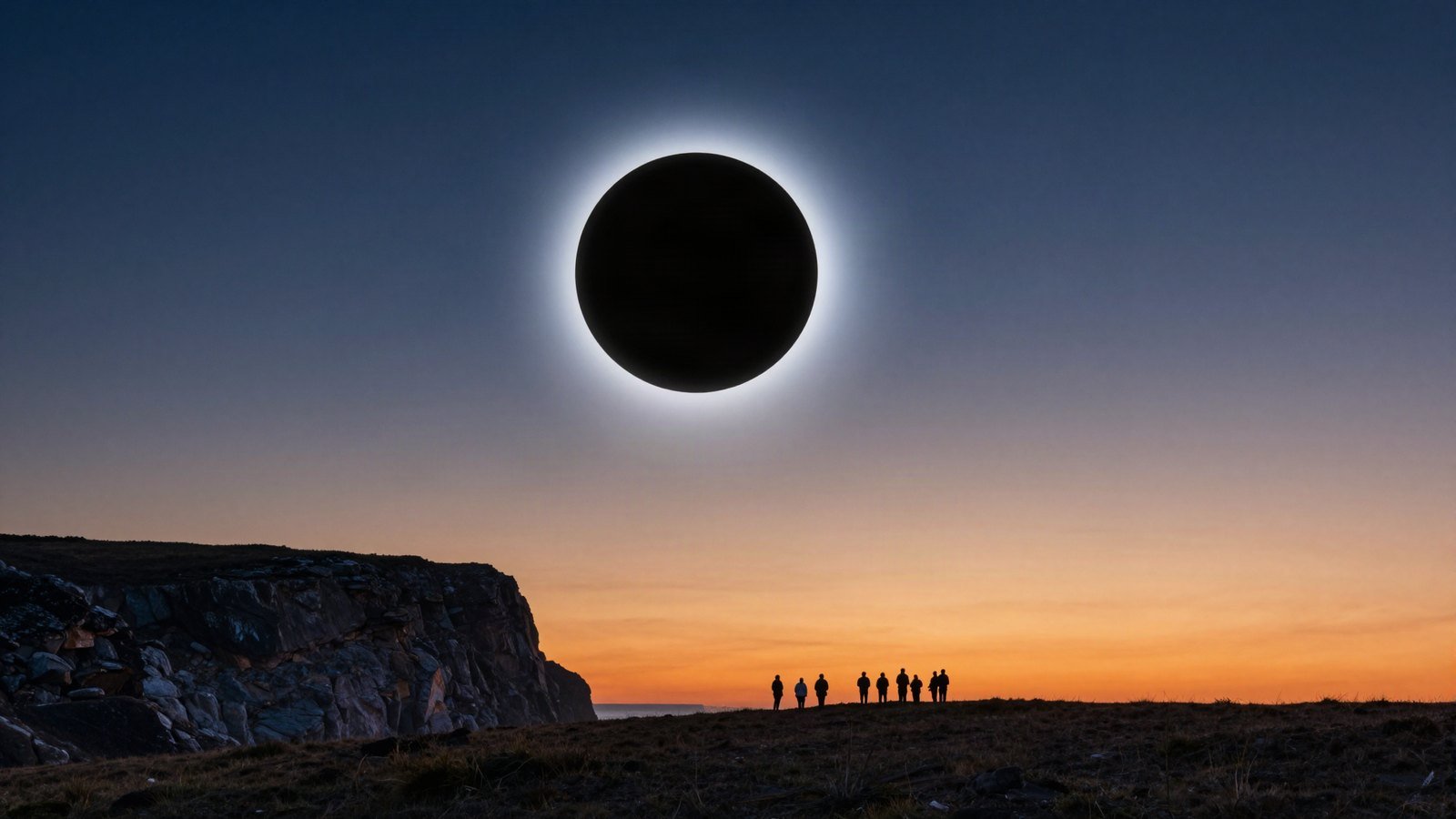
What made this eclipse visually singular was its timing. The shadow reached Iceland in late afternoon and Spain in late evening, with totality arriving shortly before local sunset. A totally eclipsed Sun hanging low over the horizon, corona flaring around a black disc above landscape rather than overhead, is among the rarest configurations eclipse chasers can witness.
The low angle also concentrated the visual drama: observers in the path described the shadow's approach as visible weather, a wall of darkness sliding across the Atlantic sky, with sunset colours ringing the entire horizon during totality.
The path and the crowds
The corridor of totality was narrow and largely maritime, which made the accessible land crossings, Iceland's west including the Reykjavik region, and a band of northern Spain, the gathering points for millions of residents and travellers. Spanish authorities and tourism operators had prepared for years for the influx, with viewing events across the region and CNN among the outlets running live global coverage as the shadow crossed.
Outside the path, a partial eclipse was visible across a much wider swath of Europe, the North Atlantic and parts of North America, though partial phases, however deep, never deliver the sensory rupture of totality.
The science riding along
Every totality is a field laboratory. The eclipsed minutes expose the solar corona to ground instruments that normally cannot separate it from the Sun's glare, and the 2026 event's low-elevation geometry offered atmospheric scientists an unusual dataset on how eclipse cooling propagates near sunset.
NASA's eclipse programme highlighted the event as the opening act of a strong European run: Spain sits near the paths of further eclipses in 2027 and 2028, a clustering that has energised the continent's astronomy infrastructure after decades of waiting.
A night sky double feature
The calendar added a flourish no planner could have scripted: the eclipse fell on the same date as the Perseid meteor shower's peak, and the new moon that made totality possible also guaranteed ideally dark skies for the meteors that followed overnight.
Observers in the eclipse path who stayed out after twilight were rewarded with one of the year's best meteor displays under moonless conditions, a same-night pairing of the sky's two most democratic spectacles.
Spain's 121-year wait, in context
Eclipse paths are indifferent to geography's fairness: totality traces a band barely a hundred miles wide across a planet mostly covered in ocean, and any fixed point waits centuries on average between visits. Spain's 1905 eclipse belonged to another world, observed with brass instruments and reported by telegraph; Tuesday's was livestreamed from the same provinces.
The country's astronomy community has treated the drought's end as a generational opportunity, with observatories, universities and regional governments coordinating public viewing at a scale usually reserved for sporting events. The investment has a long tail: the same infrastructure serves the 2027 and 2028 events.
Totality as a mass experience
The 2017 and 2024 American eclipses demonstrated what happens when totality crosses populated regions in the social-media era: multimillion-person migrations, sold-out regions, and a measurable spike in public engagement with astronomy. Europe's 2026 edition, arriving at the height of the tourist season on an accessible path, produced the continental version of that phenomenon.
The experience itself remains stubbornly unphotographable, the 360-degree sunset, the temperature drop, the corona's texture, which is why eclipse chasers speak of paths and dates the way others plan pilgrimages. Millions of Europeans joined that community on Tuesday evening.
The next dates that matter
For those who missed Tuesday, the wait is mercifully short by eclipse standards. The August 2027 total eclipse will cross southern Spain and North Africa with a far longer totality, and 2028 brings another path through the region.
The 2026 event's legacy may ultimately be logistical: it was Europe's dress rehearsal for a run of eclipses that will make the continent the sport's home ground for the rest of the decade.
Sources
- NASA Science - Total solar eclipse on August 12, 2026
- CNN - Live updates: total solar eclipse sweeps across Europe
- timeanddate.com - Total solar eclipse August 12 2026
- National Eclipse - 2026 eclipse maps for Iceland and Spain
You may also like to read

Spain Declares National Emergency as Wildfires Spread Near Madrid
Spain declared a national emergency and deployed the army as wildfires near Madrid and Avila forced tens of thousands to flee or shelter.

France becomes the first EU country to ban social media for children under 15
Lawmakers approved a sweeping prohibition from September, but stripped out the age-verification system meant to enforce it, leaving big questions.

US Airstrikes Hit Tehran Area for First Time as Iran Counts Rising Toll
American strikes reached the Iranian capital's outskirts on day five of renewed war, with Iran reporting 35 dead and its negotiator calling the fight existential.

China's economy grows just 4.3% in the second quarter, its weakest pace since late 2022
Official data show Chinese growth slipping below Beijing's 4.5-5% target band, as weak consumption and investment offset an export boom powered by AI demand.