Russian Missiles and Jet-Powered Drones Kill 18 Across Ukraine as Kyiv's Interceptor Stocks Run Down
A nine-hour overnight barrage and daytime strikes brought down a nine-storey block in Kyiv, with air defences firing off scarce Patriot rounds.
Commentary & Analysis ·
Verified key facts
- At least 18 people were killed across Ukraine in strikes on 19 and 20 August, the majority of them in Kyiv, according to Al Jazeera
- Russia launched at least 44 missiles, of which Ukrainian forces intercepted 39, alongside jet-powered drones, Al Jazeera reported
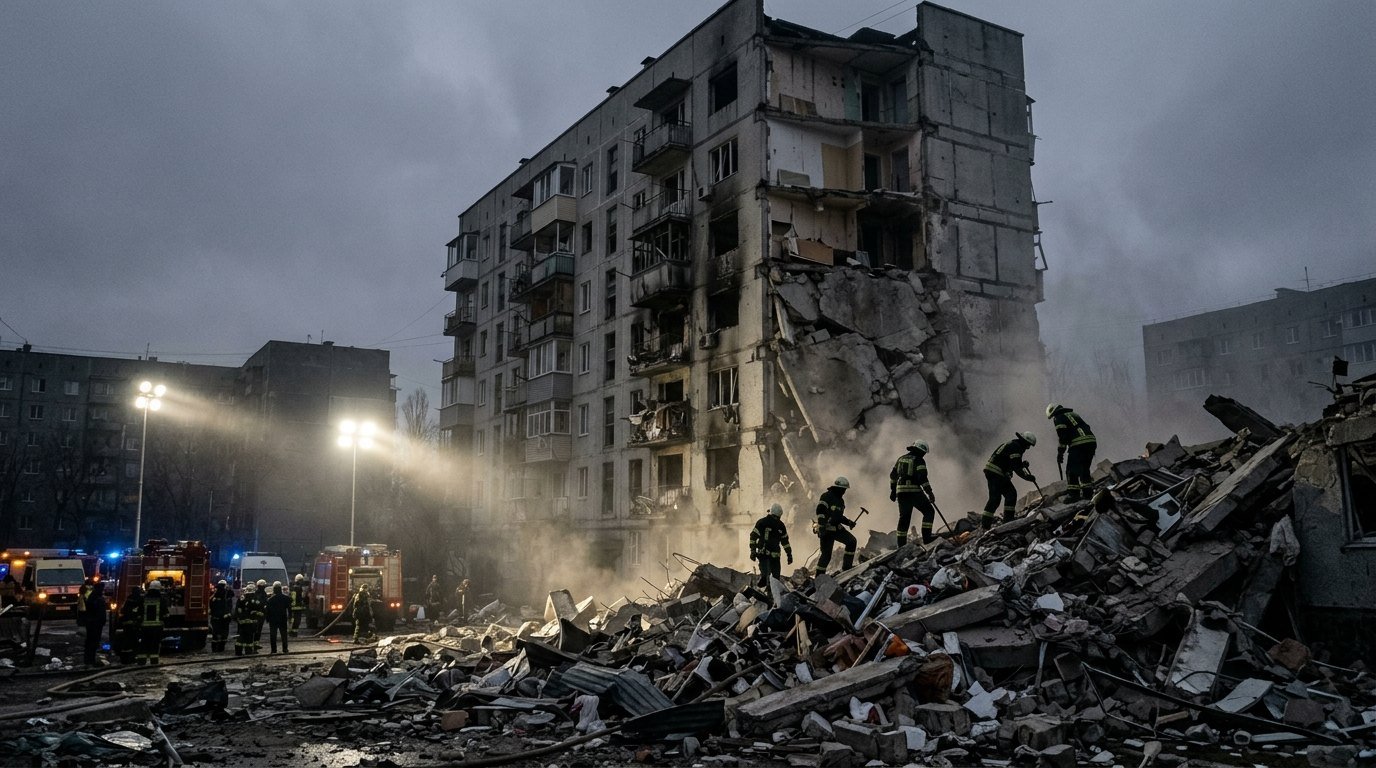
- A nine-storey residential building in Kyiv's Solomianskyi district collapsed and caught fire, and a children's hospital was damaged, mayor Vitali Klitschko said on Telegram
- Al Jazeera reported that Ukraine faces a critical shortage of Patriot interceptor missiles heading into the heating season
- Russia's defence ministry said it had struck military-industrial facilities, a transport and logistics centre and warehouses, and claimed to have downed 726 Ukrainian drones overnight
- Ukraine's parliament confirmed Yevhenii Khmara as defence minister by 312 votes to two, per Al Jazeera
- Former defence minister Mykhailo Fedorov, removed in July 2026, released a video calling for wartime elections and describing a systemic crisis of governance
Nine hours of sirens, then a daytime second wave
The air-raid alert over Kyiv ran for roughly nine hours through the night of 19 August, and when it lifted the attack did not stop. Al Jazeera reported that Russian forces followed the overnight barrage with daytime strikes on Thursday, using jet-powered drones against the capital and the surrounding oblast after the missile salvo had passed.
By the end of the two days at least 18 people had been killed across the country, the majority of them in Kyiv itself and at least one in the surrounding region. Four districts of the capital were struck: Holosiivskyi, Sviatoshynskyi, Solomianskyi and Shevchenkivskyi.
The pattern of a long night followed by a daylight follow-up has become familiar over the summer, and it is designed to exhaust rather than surprise. Crews clearing rubble in daylight are working under the same threat that put the rubble there.
Forty-four missiles, thirty-nine stopped
The interception figures tell two stories at once. Al Jazeera reported that Russia launched at least 44 missiles and that Ukrainian air defences brought down 39 of them, a rate that on paper looks like a successful night for the defenders.
The five that got through killed most of the people who died. That is the arithmetic Ukrainian commanders have been describing for months: at these volumes an interception rate close to 90 per cent still leaves a lethal remainder, and each interception consumes a round that cannot easily be replaced.
Alongside the missiles came jet-powered drones, a category Russia has expanded through the year because they fly faster than the propeller-driven types and force defenders to expend more capable, and more expensive, interceptors against them.
The building that came down in Solomianskyi
The heaviest single loss of life in the capital came in Solomianskyi, where a nine-storey residential building collapsed and caught fire. Kyiv's mayor, Vitali Klitschko, reported the collapse on Telegram along with damage to a children's hospital elsewhere in the city.
Rescue work at a partially collapsed apartment block is slow and dangerous, and the casualty count from such a strike typically climbs over the following day as crews reach the lower floors. The figures reported on Thursday were provisional for that reason.
Damage to a children's hospital in the same period is the detail that has travelled furthest internationally, and it is the kind of incident that has previously prompted formal condemnations from the United Nations and from European capitals.
An air-defence shortage with a winter deadline
Behind the individual strikes sits a supply problem that Ukrainian officials have raised repeatedly through the summer. Al Jazeera reported that Ukraine is critically short of Patriot interceptor missiles, the system that gives it its only reliable answer to Russian ballistic missiles.
The correspondent Audrey MacAlpine set out for Al Jazeera why the timing matters: the shortage becomes a far more serious problem once Russia begins concentrating on energy infrastructure, the sites that keep heat and electricity running through the winter.
That is not a hypothetical sequence. In each of the previous heating seasons Russia has shifted its long-range campaign towards generation and transmission as the temperature dropped, and the Ukrainian grid has entered each winter with less redundancy than the one before.
Moscow's account of the same night
Russia's description of the operation bears no relation to the damage recorded in Kyiv's residential districts. Its defence ministry said the strikes had targeted military-industrial facilities, a transport and logistics centre and warehouses, the standard formulation it uses after long-range attacks on Ukrainian cities.
The ministry also claimed that its own air defences had shot down 726 Ukrainian unmanned aerial vehicles between Wednesday evening and Thursday morning, a figure that, if accurate, would indicate a Ukrainian long-range campaign of comparable intensity running in the opposite direction.
Neither side's claims are independently verifiable in real time. What is verifiable in Kyiv is the collapsed block in Solomianskyi and the casualty figures issued by the city and national authorities.
A new defence minister confirmed mid-barrage
Ukraine's parliament confirmed Yevhenii Khmara as defence minister during the same 48 hours, by 312 votes to two. In his remarks after the vote he said he would do everything to defend Ukraine, reduce Russia's war potential as far as possible, and force the enemy into a just peace.
President Volodymyr Zelenskyy framed the appointment as evidence of the country's needs rather than of its stability, saying the confirmation was a sign that Ukraine needs more strength, and that it will have it.
The vote followed the removal of Mykhailo Fedorov as defence minister in July. Fedorov has since released a video calling for elections to be held in wartime and arguing that Ukraine faces a systemic crisis of governance, and dozens of demonstrators rallied in Kyiv in support of that position.
Independence Day on 24 August falls in this week
Ukraine marks its Independence Day on 24 August, four days after the strikes described here, and the anniversary falls in the middle of a period in which the country's interceptor reserves are already stretched.
For Kyiv's air-defence planners the question over the coming days is one of allocation rather than capability: which cities and which categories of target receive protection from a stock of Patriot rounds that cannot cover all of them, and how much of that stock is spent before the heating season begins.
For the residents of Solomianskyi the more immediate question is the search of the collapsed block, which was still under way when the figures in this report were issued.
Sources
- Al Jazeera - At least 18 people killed in Ukraine as Russia carries out more attacks
- Al Jazeera - Russian attacks kill 17, exploiting Ukraine's lack of missile interceptors
- Euronews - Latest news bulletin, 21 August 2026
- Anadolu Agency - Morning briefing, 21 August 2026
You may also like to read
Ukraine and Russia Trade Deadly Drone Strikes as the Air War Reaches Far Behind the Front
Long-range drone attacks struck Russian regions and Ukrainian cities in early August, both sides claiming military targets as casualty reports stayed unverified.
Ukraine and Russia trade long-range strikes as both sides report civilian deaths
Kyiv reported deadly Russian strikes on defence and residential sites, while Moscow said Ukrainian drones hit factories deep inside Russia.
Russian Strikes on Ports, Cities and Energy Sites Keep Civilian Pressure on Ukraine
Attacks near Mykolaiv and drone waves across several regions kept pressure on Ukraine's ports and power, with Moscow and Kyiv describing the targets differently.
Romania's Drone Interception Renews Fears the Ukraine War Could Spill Into NATO Territory
Romania said a fighter jet downed a suspected Russian drone after repeated airspace incidents, testing NATO's rules on attribution and escalation near the border.