Romania's Drone Interception Renews Fears the Ukraine War Could Spill Into NATO Territory
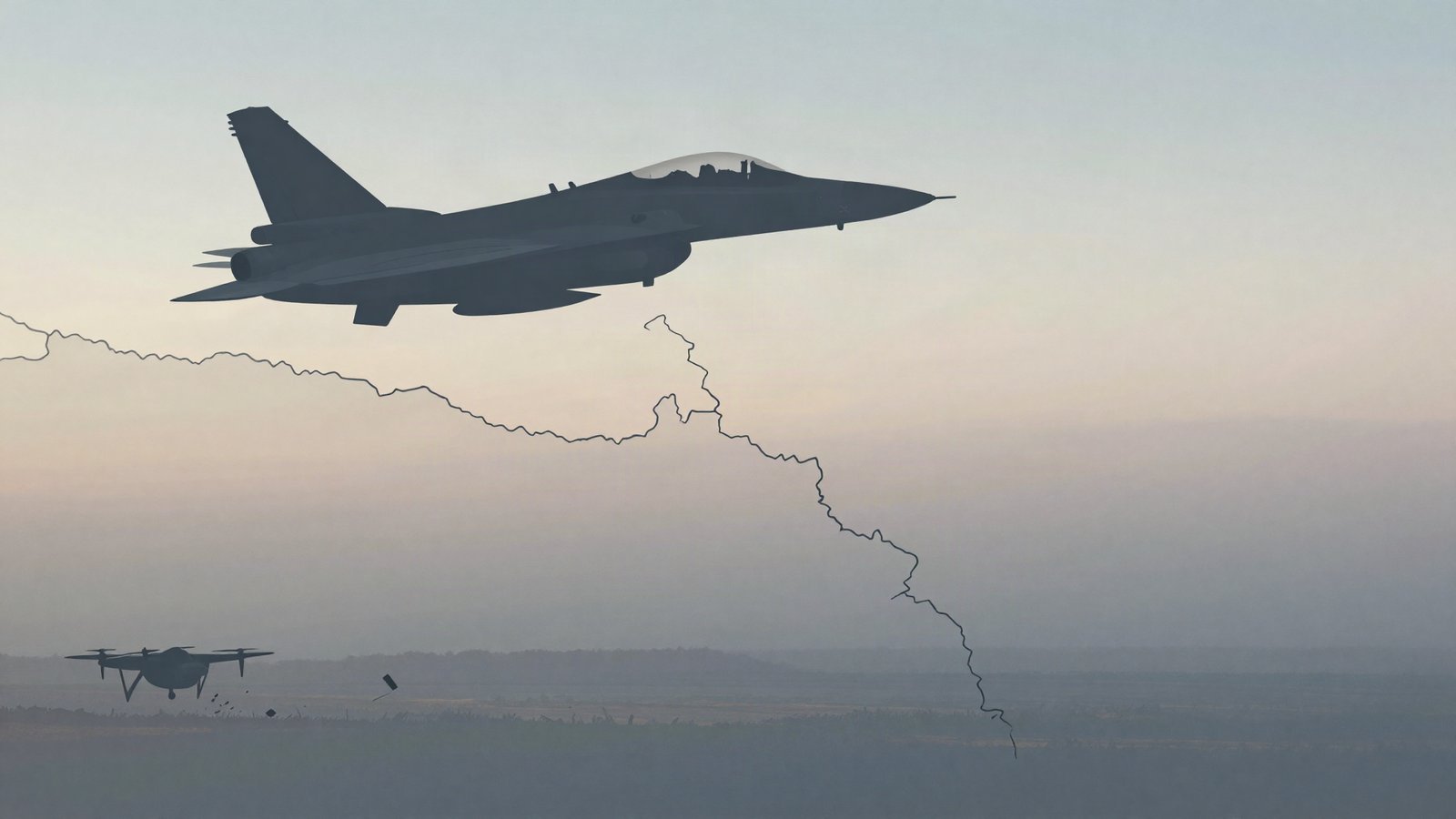
Romania said a fighter jet downed a suspected Russian drone after repeated airspace incidents, testing NATO's rules on attribution and escalation near the border.
Commentary & Analysis ·
Verified key facts
- Romania said one of its fighters shot down a suspected Russian drone, according to Al Jazeera and NATO statements.
- The interception followed repeated airspace incidents near the Ukrainian border.
- Bucharest described the action as defensive protection of its territory.
- Moscow has often disputed or minimised responsibility for cross-border drone incidents.
- NATO consultations focus on air surveillance and rules of engagement rather than automatic escalation.
A drone down over NATO soil
Romania said one of its fighter jets shot down a suspected Russian drone after a series of airspace incidents near its border with Ukraine. The account drew on Al Jazeera and statements from NATO. Romanian aircraft responded to the intrusion while authorities examined debris and flight paths. The interception revived a persistent worry: that the war next door could spill, even inadvertently, onto the territory of the alliance.
The episode was, in the immediate sense, a defensive act over a member state's own airspace. But because Romania belongs to NATO, any incident involving a foreign drone crossing its border carries implications far beyond the local. It tests the alliance's rules on attribution, its thresholds for response and its capacity to manage escalation without overreacting.
How each side described it
Bucharest framed the action as the legitimate defence of its territory, a straightforward exercise of the right to protect its own airspace. Moscow, consistent with its posture toward earlier cross-border incidents, has generally disputed or minimised responsibility for such intrusions. That divergence is characteristic: the country whose airspace is breached asserts a clear violation, while the party linked to the drone declines to own it.
The gap matters because attribution is the hinge on which any response turns. Establishing whether a drone was Russian, whether its crossing was deliberate and what its purpose was requires technical investigation of debris and flight data. Authorities said that work was under way, but it takes time to complete.
The people who live along the border
For communities near the frontier, the abstractions of alliance politics translate into concrete disruption. Border residents face warnings, shelter orders and the risk of falling debris even when an incident is not intended as an attack on NATO. A drone that strays across the line, whatever its purpose, can send families to shelters and scatter wreckage across fields and roads.
That everyday reality has become more familiar as incursions recur. Each event, however contained, reminds those living in the borderlands that the war's hazards do not stop neatly at national boundaries.
Local authorities have at times issued alerts and guidance during such episodes, and the recurrence tends to weigh on daily life. Farmers, commuters and schools near the frontier must factor in the possibility of disruption, a burden that accumulates quietly over time. For these communities, the debate over whether an incident counts as an attack on the alliance can feel remote from the immediate task of staying safe.
Why escalation control is delicate
The danger in such incidents lies less in any single drone than in the possibility of miscalculation. Misidentification or casualties could trigger a larger crisis, turning a stray craft into the spark for a broader confrontation. At the same time, repeated incursions carry a subtler risk: they can normalise the abnormal, dulling alarm while steadily consuming allied air-defence resources.
Managing that balance is the core challenge. Treating every intrusion as an act of war would risk uncontrolled escalation; treating none seriously would invite further probing. NATO's approach has sought a middle path.
How the alliance is responding
NATO consultations have focused on air surveillance, rules of engagement and reassurance to exposed members, without treating every intrusion as an automatic trigger for collective defence. The emphasis is on monitoring, clear procedures and visible support for frontline states, calibrated to deter without inviting a spiral. Romania's interception will feed into that ongoing calibration.
Background: a recurring worry
Concerns about spillover have accompanied the war since its early months, with debris and stray munitions occasionally reported in neighbouring states. Each such episode has prompted questions about how NATO would respond to an incident on its soil. The alliance has consistently favoured investigation and measured statements over rapid escalation, a pattern the latest event appears to continue.
Romania's position gives such incidents particular salience. Its long border with Ukraine, running near active zones of the war, places it among the alliance members most exposed to stray drones and debris. That geography has made air-policing and surveillance a sustained priority, and it explains why an interception there draws attention that a similar event deeper inside the alliance might not.
Underlying NATO's approach is a deliberate effort to avoid overreaction. The alliance's collective-defence commitment is a powerful deterrent precisely because it is not invoked lightly. Treating an ambiguous incursion, whose origin and intent are still under investigation, as a deliberate attack would risk a spiral neither side may want. By insisting on attribution and investigation first, the alliance preserves both its credibility and its room to manoeuvre, a calculation visible in the careful language following Romania's action.
The technical investigation
Several threads will show how the incident is absorbed.
- The technical investigation into the drone's origin and flight path
- Formal NATO statements and any collective response
- Russia's reaction to the attribution
- Adjustments to regional air-policing missions
- Whether incursions near the border continue or intensify
Romania's downing of the drone was a limited event with outsized implications. It underscored how a war fought largely within Ukraine keeps brushing against the alliance's edge. Much depends on the discipline with which such moments are investigated, attributed and managed.
Sources
- Al Jazeera - Romania shoots down suspected Russian drone
- NATO - Official news and statements
You may also like to read
Ukraine and Russia Trade Deadly Drone Strikes as the Air War Reaches Far Behind the Front
Long-range drone attacks struck Russian regions and Ukrainian cities in early August, both sides claiming military targets as casualty reports stayed unverified.
Russian Strikes on Ports, Cities and Energy Sites Keep Civilian Pressure on Ukraine
Attacks near Mykolaiv and drone waves across several regions kept pressure on Ukraine's ports and power, with Moscow and Kyiv describing the targets differently.

Wildberries Warehouses Become a Flashpoint in Ukraine's Campaign Against Russia's War Economy
A Samara warehouse fire after a reported Ukrainian drone strike renewed debate over dual-use logistics, economic warfare and the workers caught in between.

Zelenskyy and Trump Talks Fold Sanctions, Weapons and the Iran War Into One Agenda
As Zelenskyy prepared to meet Trump and the US Senate weighed new sanctions, Ukraine diplomacy became entangled with the Iran conflict and pressure on US resources.