Northwest Indiana Is Entering a Second Week Without Power
Northwest Indiana entered a second week of outages after the 11 August storm, disrupting food, schools, communications and daily life across Gary.
Commentary & Analysis ·
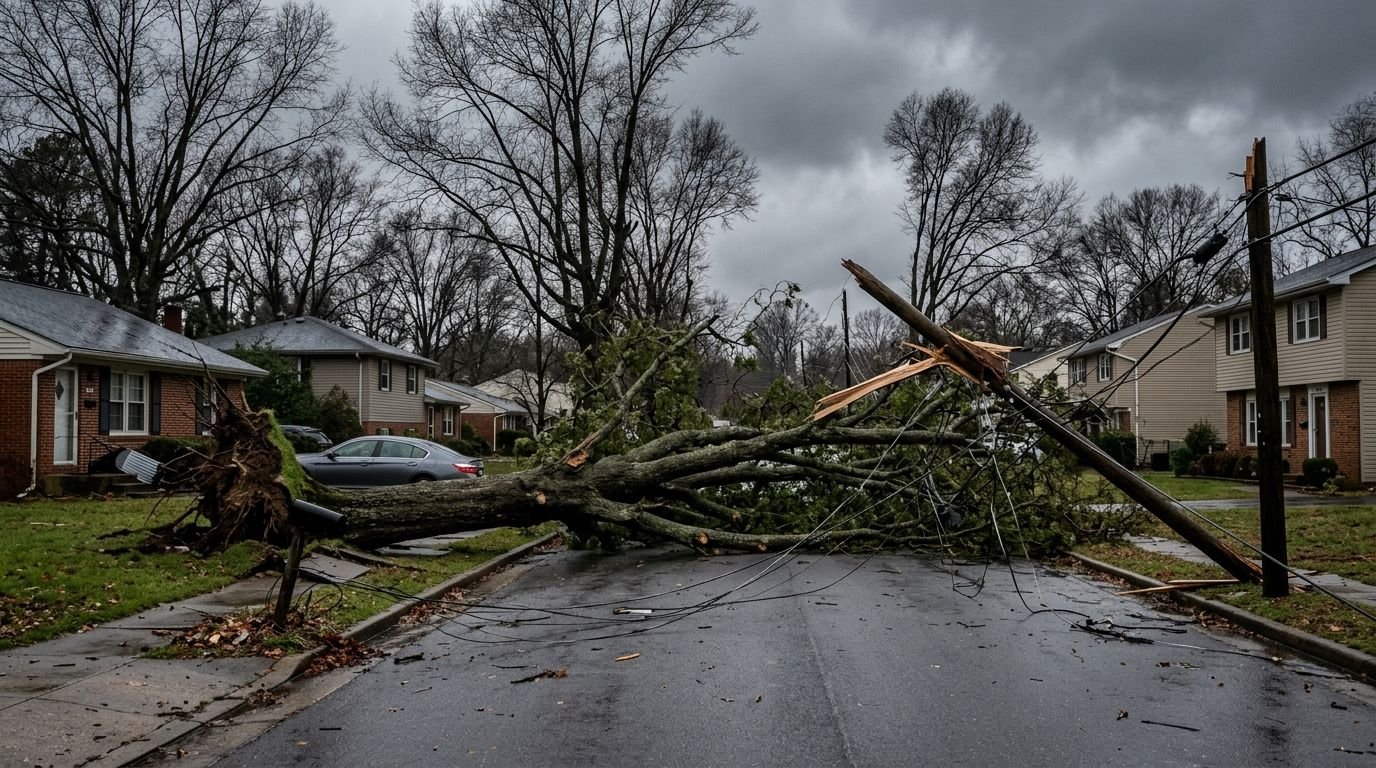
Nine days is long enough for a power cut to stop being an inconvenience. Northwest Indiana power outages have closed schools, spoiled food and left thousands hunting for somewhere to charge a phone. Why has it taken this long? The engineering answer is more revealing than the frustration.
Verified key facts
- Associated Press: Tens of thousands of customers remained without electricity more than a week after the 11 August storm brought winds up to 99mph.
- Associated Press: On the ninth day, residents were throwing out spoiled food, queueing for hot meals and searching for places to charge phones.
- WNDU/AP: Gary's roughly 4,300-student school district had been closed since 13 August because of outages and storm damage.
- Portage Township Schools: Its planned 12 August start was postponed, with a new target of 25 August after power, tree and building-safety problems.
- Associated Press: NIPSCO said hundreds of poles required replacement and full restoration in Gary could extend to 25 August.
What does a second week of Northwest Indiana power outages feel like?
Imagine opening the refrigerator on day nine and knowing everything inside has to go. Then imagine the phone battery is low, school is closed and the utility still cannot give your street an immediate restoration time. That is the household reality behind the Northwest Indiana power outages after the 11 August storm. Associated Press reporters found residents in Gary describing 'survival mode' as they queued for hot meals and charging points. The storm itself lasted hours; the social disruption is lasting far longer. The recovery has become a test of how quickly an ageing, tree-lined distribution network can be rebuilt after damage that utilities describe as unprecedented.
Why has restoring power taken more than a week?
This was not a routine outage caused by a handful of tripped lines. Associated Press reported winds up to 99mph, widespread tree damage and the need to replace hundreds of utility poles, including major transmission structures. Electricity restoration follows a hierarchy: transmission lines and substations first, then large distribution circuits, then smaller neighbourhood faults and individual service connections. A crew may restore thousands of customers by repairing one upstream fault, while the final few streets require time-consuming work at many separate locations. NIPSCO has brought in hundreds of workers, but each broken pole can require clearing debris, making the site safe, replacing equipment and restringing wire before power can return.
Why has Gary been hit especially hard?
Gary combines dense overhead infrastructure with mature trees and communities where household resources can be limited. More than 20,000 customers there were still without service in Associated Press reporting on 19 August, and restoration estimates extended towards 25 August. Utility officials have rejected claims that restoration priorities were based on neighbourhood income or race, saying the order reflects system damage and the number of customers affected by each repair. Residents nevertheless experience the outage through unequal personal buffers. A household with a generator, spare vehicle and money for hotel rooms can manage days without power very differently from a renter who loses a week's groceries and cannot miss work.
How are the outages disrupting schools?
The power failure has collided with the beginning of the academic year. WNDU, carrying Associated Press reporting, said Gary's school corporation, which serves about 4,300 students, had been closed since 13 August. Portage Township Schools was supposed to begin classes on 12 August but postponed the start. The district's own update set 25 August as the new goal after only three of its schools had power on 17 August and crews were still dealing with downed trees, damaged property and unsafe sidewalks. Reopening a building requires more than electricity: fire alarms, HVAC, internet, phones, food storage and safe routes all have to be checked.
What are the hidden health costs of a long blackout?
Spoiled food is the most visible loss, but prolonged outages create a wider chain of risk. Refrigerated medicines can become unusable. People who rely on powered medical devices need charging or relocation. Generators can cause carbon-monoxide poisoning when used improperly. Heat and humidity make homes harder to tolerate, while dark streets and non-functioning traffic signals add safety problems. Community meal sites and charging centres therefore function as public-health infrastructure, not just convenience. The longer restoration takes, the more the burden shifts from the utility system to local government, charities, neighbours and families. That shift is particularly severe for older residents and households without reliable transport.
Why are residents questioning vegetation management and grid resilience?
After major storms, arguments quickly turn from weather to preparation. Some residents and a class-action lawsuit have questioned whether tree trimming and infrastructure maintenance were adequate before 11 August. NIPSCO says it has increased vegetation-management spending and that the storm's scale, not neglect of particular communities, explains the damage. Both claims can be tested through records: trimming cycles, inspection schedules, outage histories, pole age and capital spending. Regulators will also want to compare this recovery with nearby utilities exposed to the same weather. The useful policy question is not whether every storm can be prevented from causing outages; it is whether reasonable investment could have reduced the duration and concentration of the damage.
Will Gary and Portage be ready by 25 August?
The date now carrying the most weight is 25 August. NIPSCO has used it as an outer restoration estimate for parts of Gary, while Portage Township Schools has targeted the same day for a delayed first day of classes. Meeting that timetable requires power restoration, cleared streets, repaired school property and successful safety checks. Missing it would deepen both household costs and public frustration. Even if electricity is restored by then, the recovery will continue through insurance claims, food replacement, school catch-up and scrutiny of the grid. For residents who have already spent more than a week improvising basic routines, the practical end of the emergency will be measured at the socket, not in a utility progress percentage. Restoration also gets slower near the end of a major outage because the remaining failures are often scattered and labour-intensive. Replacing a transmission component can restore thousands of customers at once; repairing individual service drops, damaged poles and neighbourhood circuits may bring back only dozens at a time. That arithmetic is brutal for the households still dark on day nine because systemwide progress can look impressive while their own street sees no change. For schools, grocers and families, the relevant measure is therefore not only the percentage restored but the reliability of local estimates, access to cooling and charging, and reimbursement or emergency support for losses that cannot be recovered when the lights return.
Sources
- Associated Press - ninth day without power (apnews.com)
- Associated Press - tens of thousands still without power (apnews.com)
- WNDU - Survival mode in northwest Indiana (www.wndu.com)
- Portage Township Schools - storm recovery update (www.portage.k12.in.us)
- Gary Community School Corporation - closure updates (www.garycsc.k12.in.us)
- Note: Outage totals and restoration estimates change throughout the day. Use the latest NIPSCO and school-district updates for service-specific advice.
You may also like to read

Texas Is Baking Above 100F. Why Does a 112F Heat Index Matter More?
Texas faces dangerous triple-digit heat, with Houston heat-index readings forecast as high as 112F and extreme heat warnings around Dallas.

Texas Hill Country Faces Flash Flood Emergency a Year After Its Deadliest Deluge
A flash flood emergency covers Kerr County and Uvalde as torrential rain returns to the Texas Hill Country a year after floods that killed more than 130.
A Tornado Tears Through a Long Island Beach Club as Storms Pummel the Northeast and Nassau County Declares an Emergency
A suspected twister destroyed around 50 cabanas at Atlantic Beach as flooding and storm damage spread across the region, with one minor injury reported.
Alisa Goods Was Found Near Las Vegas Airport. How Did the Search Miss Her?
Police say surveillance shows Alisa Goods fell near Las Vegas airport and later collapsed, while mystery texts were likely sent by spoofing scammers.