A Projectile Strike on a Cargo Ship Leaving Hormuz Kills a Crew Member, as Trump Insists the Strait Is 'Open and Operating'
UKMTO said a projectile hit the vessel's engine room as it exited the strait near Khasab, Oman; crossings have fallen to their lowest since May, per Kpler.
Commentary & Analysis ·
Verified key facts
- A projectile struck a cargo ship exiting the Strait of Hormuz, damaging its engine room and killing one crew member, the United Kingdom Maritime Trade Operations centre said, per CNBC
- The incident occurred near Khasab, Oman, and the surviving crew are being assisted by the Omani Coast Guard, UPI reported
- President Trump said on Tuesday the strait is 'open and operating', per CNBC
- Observed ship traffic through Hormuz stood at a five-day average of 10 crossings, the lowest since May, according to Kpler data cited by CNBC
- The New York Times reported two ships transiting the strait were attacked as oil prices rose
- The Wall Street Journal reported oil prices climbed after a reported tanker seizure by Iran
A fatal strike at the mouth of the strait
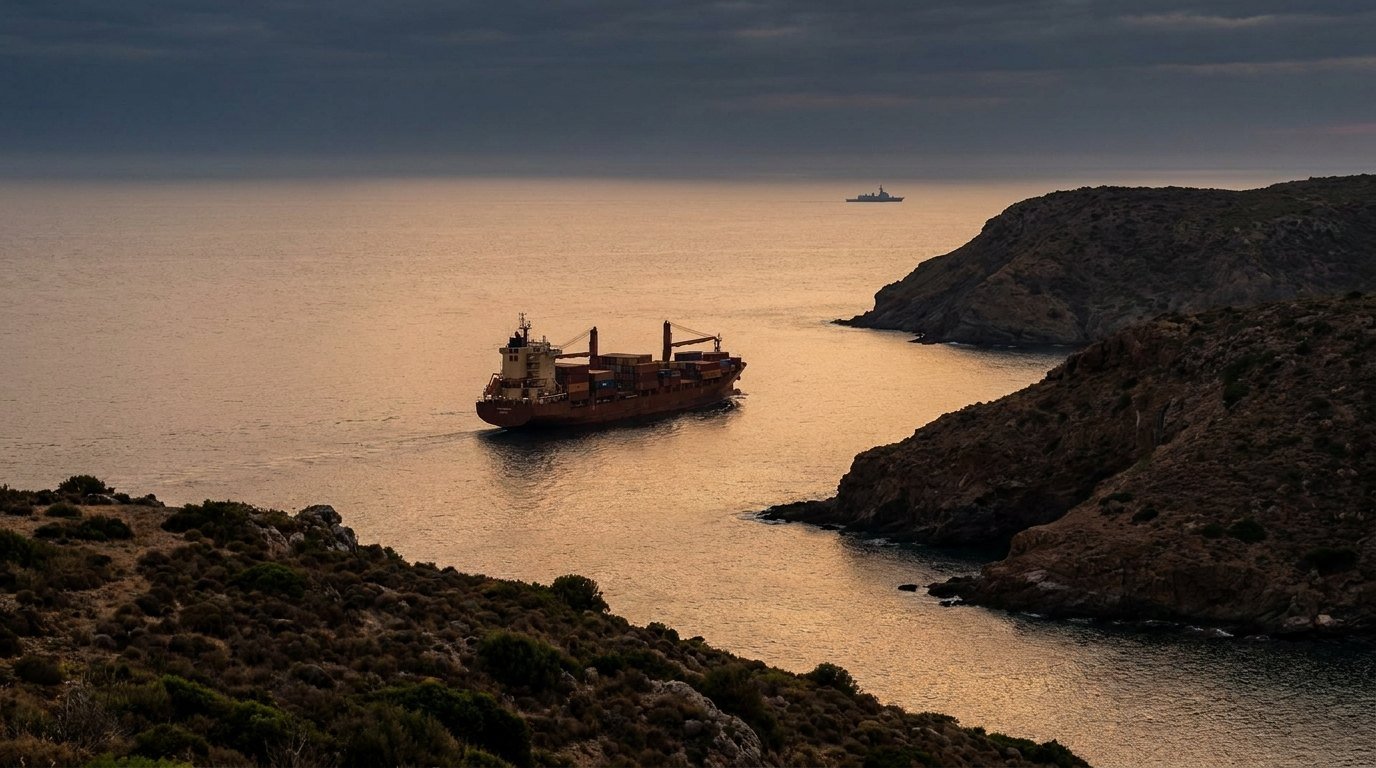
A cargo ship came under attack while exiting the Strait of Hormuz on Tuesday, leaving one crew member dead, maritime security agencies said. A projectile struck the vessel and damaged its engine room, according to the United Kingdom Maritime Trade Operations centre, the Royal Navy-linked body that tracks incidents in the region, as reported by CNBC.
The incident occurred near Khasab, the Omani town that sits on the Musandam peninsula at the narrowest point of the waterway, UPI reported. The surviving crew are being assisted by the Omani Coast Guard. The name, type and flag state of the damaged ship had not been released by Tuesday evening, and no party has been identified as responsible for the strike.
Two vessels attacked as oil moves higher
The New York Times reported that two ships transiting the strait were attacked as oil prices rose, underlining that Tuesday's fatal strike was not an isolated event. The Wall Street Journal separately reported that crude climbed after a reported tanker seizure by Iran, though details of that vessel and its cargo remained unconfirmed.
The pattern fits months of escalation in the waterway. Iran has repeatedly attacked ships sailing the American-protected southern route in an effort to shut down the corridor, demanding that vessels instead take a northern route through its own territorial waters, according to CNBC's reporting on the campaign.
Trump's message: the strait is open
President Donald Trump said on Tuesday that the Strait of Hormuz is 'open and operating', per CNBC, a formulation aimed at reassuring markets and shippers that the American naval escort system through the southern corridor is holding.
The gap between that message and the behaviour of shipowners is the story. Observed traffic through Hormuz stood at a five-day average of just 10 crossings, the lowest since May, according to Kpler data cited by CNBC. Owners and insurers are voting with their hulls, and a fatal strike on a vessel that was already on its way out of the Gulf will not change that calculus in the corridor's favour.
The economics of a fifth of the world's oil
Before the war, roughly 20 million barrels per day of crude and refined products moved through Hormuz, about a fifth of global oil consumption, per CNBC. Flows collapsed in the spring, falling as low as 1.6 million barrels per day in May, before the escort system rebuilt volumes to about 4 million in June and 5 million in July.
Each attack tests whether that recovery can continue. Insurance premiums for Gulf transits reprice with every incident, and a confirmed crew fatality typically moves war-risk rates more than damage to a hull does. For tanker operators, the arithmetic of a Hormuz run is now a calculation about crew safety as much as cargo value.
Oman's uncomfortable position
The strike's location, in waters near Khasab, places the incident close to Omani territory rather than in the mid-channel lanes where earlier attacks clustered. Oman has spent the conflict as the region's quiet intermediary, hosting back-channel contacts while its coast guard has repeatedly rescued and assisted crews from stricken vessels, as it did again on Tuesday, per UPI.
IranWire reported the death as the latest in a series of merchant-marine casualties in the strait this year, a toll borne overwhelmingly by seafarers from South and Southeast Asia who crew the world's tanker and cargo fleets.
What this run of attacks has already changed
The campaign in the strait has redrawn shipping economics across the region. Owners that once treated Hormuz as routine now route around the Gulf entirely where cargoes allow, and the pipeline projects designed to bypass the strait have moved from contingency planning to boardroom priority.
The attacks have also hardened into a war of narratives: Tehran insists the southern corridor is unsafe and its own northern route is the lawful path; Washington insists the strait is open under escort. Tuesday delivered evidence for both claims at once, a corridor that still functions and a sailor who did not survive it.
The seafarers who absorb the danger
Behind every traffic statistic is a crew, and the strait's risk has never been distributed evenly. The men and women who sail Gulf tankers and bulk carriers come overwhelmingly from the Philippines, India, Indonesia and other South and Southeast Asian maritime nations, and it is their unions and manning agencies that have pressed hardest for danger pay and the right to refuse Hormuz transits since the campaign against shipping began.
Tuesday's death sharpens that pressure. Seafarer welfare organisations have argued through the crisis that decisions about whether a corridor is 'open' are made in capitals and boardrooms by people who will never sail it, while the consequences land on crews with little practical ability to decline a voyage written into their contracts.
The industry's compromise so far has been money and routing: war-risk bonuses for Gulf legs, crew changes shifted to ports outside the region, and citadel drills revived from the piracy era. None of it stops a projectile, as the damage to Tuesday's vessel demonstrated.
The next Kpler count will show whether owners believed him
The measurable test of Tuesday's competing claims arrives within days: whether the five-day crossing average recovers from its May-era low of 10 transits or sinks further as owners hold vessels outside the Gulf. That number, not any statement from Washington or Tehran, is the verdict shippers deliver.
The unresolved details of the attack, the identity of the vessel, its flag, and the origin of the projectile that killed a member of its crew, will shape the diplomatic response. What is already clear is that exiting the strait, not merely entering it, has become the dangerous part of the voyage.
Sources
- CNBC - Ship attack in Hormuz kills crew member while Trump says strait is 'open and operating'
- UPI - Crew of ship sustains casualty after vessel is struck in Hormuz Strait
- The New York Times - Two Ships Transiting Strait of Hormuz Are Attacked as Oil Prices Rise
- The Wall Street Journal - Oil Prices Climb After Reported Tanker Seizure by Iran
- The Hill - Ship attacked while exiting Strait of Hormuz
- IranWire - One Dead After Vessel Struck in Strait of Hormuz
You may also like to read
Strait of Hormuz Disruption Drives Oil Risk and a Global Naval Response
Iranian actions and threats sharply cut shipping through the world's key oil chokepoint, as the US and partners escorted vessels and sought guaranteed passage.
Strait of Hormuz Put on 'Severe' Alert as Tanker Attacks Send Insurance Costs Soaring
The US Navy-led maritime centre raised Hormuz to its highest alert after Iran struck three tankers, with war-risk cover now near 5% of a ship's value.
Trump Rules Out Extending the Iran Ceasefire as Tehran Signals a Fully Offensive Posture
The temporary truce has expired with no successor deal, and a senior Iranian official says Tehran will now shift to a fully offensive military footing.
Putin Warns Europe of Reciprocal Ship Seizures as the Shadow-Fleet Standoff Hardens
Speaking aboard a missile warship, the Russian leader said Moscow will start seizing European vessels if EU states keep detaining sanction-busting tankers, and claimed conflict potential in the Asia-Pacific is growing.