Which Alfalfa Sprouts Are Recalled in the E. coli and Salmonella Outbreak?
Four people have been admitted to hospital, and four patients were infected with several pathogens at once, in an outbreak traced to a Minnesota grower.
Commentary & Analysis ·
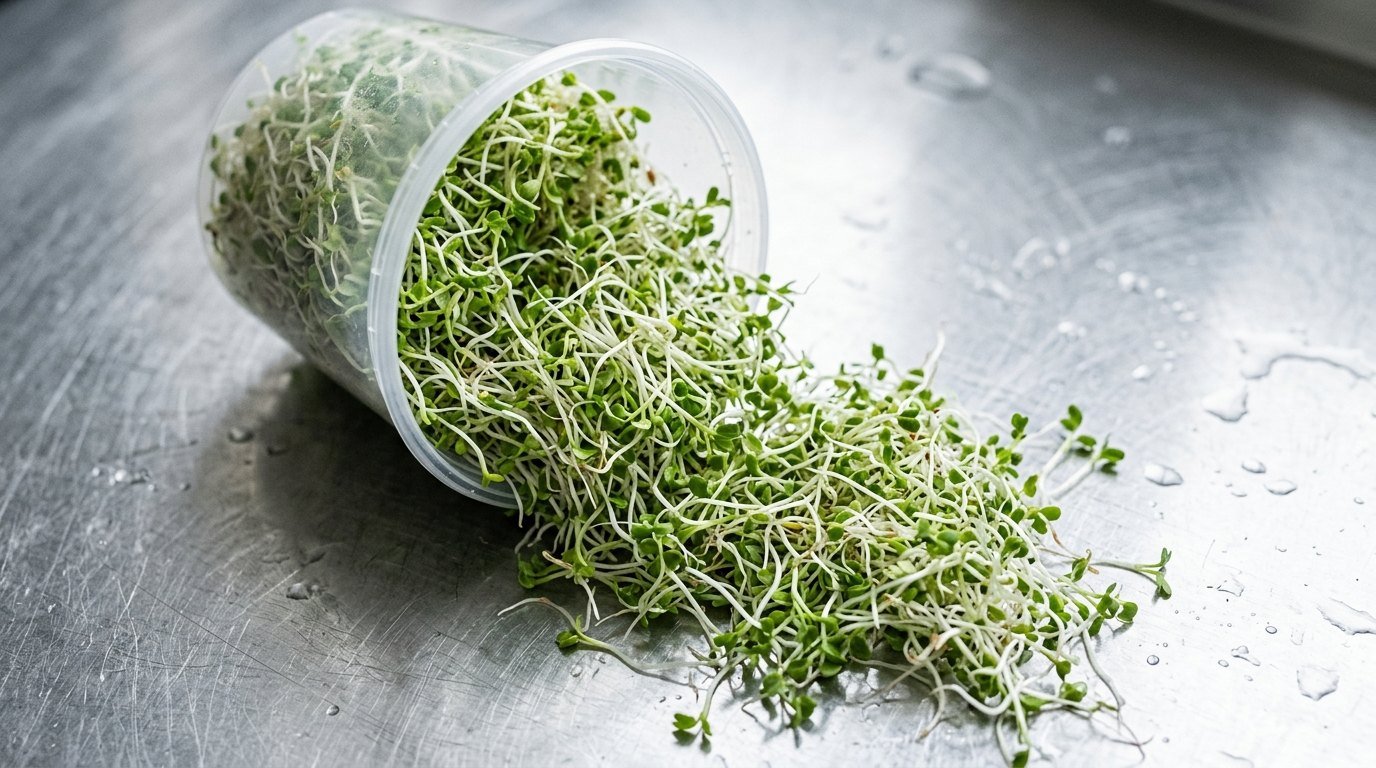
Fifty-five people across 15 states have been made ill by alfalfa sprouts, and four of them were carrying four different pathogens at once. If you buy sprouts, the names to look for are Calco and Everything Sprouts, in five-ounce lidded plastic containers. Here's what investigators found, why the first illness came ten weeks before the recall, and what the CDC wants you to do now.
Verified key facts
- Fifty-five people across 15 states have been sickened, with 46 E. coli infections, seven Salmonella infections and two people infected with both, according to ABC News.
- Four people have been admitted to hospital and no deaths have been reported, per CBS News.
- Illness onset dates run from 31 May to 8 August 2026, according to CBS News.
- The FDA identified alfalfa sprouts from Everything Sprouts, LLC of Minneapolis, Minnesota, sold under the Calco and Everything Sprouts brands.
- The CDC found four patients infected simultaneously with three E. coli strains - O26:H11, O103:H25 and O168:H8 - and Salmonella Agona.
- The FDA began an inspection and sample collection at the firm on 19 August and recommended a recall, which the company then issued.
What Investigators Found
American food-safety agencies are investigating a multi-state outbreak traced to alfalfa sprouts. ABC News reported that 55 people across 15 states have fallen ill, of whom 46 were infected with E. coli, seven with Salmonella and two with both organisms at once. CBS News reported four admissions to hospital and no deaths.
The illness onset dates run from 31 May to 8 August, according to CBS News, which means the outbreak had been accumulating cases for more than two months before the public advisory appeared. The E. coli infections involve Shiga toxin-producing strains, which can cause severe abdominal cramping, diarrhoea, fever, nausea and vomiting for up to nine days after exposure.
Multi-state outbreaks of this size are identified through genomic sequencing rather than through individual clinicians noticing a pattern. Isolates from patients in different states are matched in a national database, which is how a cluster stretching from Minnesota outwards was recognised as a single event.
Four Patients, Several Pathogens Each
The most unusual feature of the investigation is what the Centers for Disease Control and Prevention found in four of the patients. Each was infected simultaneously with three distinct E. coli strains - O26:H11, O103:H25 and O168:H8 - and with Salmonella Agona.
A single person carrying four separate pathogens at once is rare and points to a heavily contaminated common source rather than to cross-contamination somewhere down the supply chain. It is the kind of finding that narrows an investigation quickly.
Whole genome sequencing also allows investigators to say with confidence that the four organisms came from a single exposure rather than from four coincidental infections, which is the finding that made the sprout hypothesis the leading one early in the investigation.
The Grower and the Brands
The Food and Drug Administration identified the source as alfalfa sprouts distributed by Everything Sprouts, LLC of Minneapolis, Minnesota. The product reached consumers under both the Calco and Everything Sprouts brand names and was sold to restaurants as well as grocery shops, according to the agency's outbreak advisory.
The affected product was packed in five-ounce lidded plastic containers, with the heaviest distribution in Minnesota and Wisconsin, per Food Poisoning Bulletin. That regional concentration sits oddly with a case count spread across 15 states, and reconciling the two is part of what the investigation still has to do.
Restaurant distribution complicates the recall considerably. A consumer can check a container in their own refrigerator; a diner who ate a sandwich garnished with sprouts three weeks ago has no way to know, which is one reason case counts in outbreaks with food-service distribution tend to be undercounted.
Why Sprouts Keep Appearing in Outbreak Notices
Sprouts are a recurring subject of FDA warnings for a structural reason. Seeds are germinated in warm, humid conditions that are close to ideal for bacterial growth, and any pathogen present on the seed is amplified rather than diluted by the process.
The agency has advised for years that children, older adults, pregnant women and anyone with a weakened immune system should avoid raw sprouts entirely. Cooking eliminates the risk; rinsing does not, because contamination can sit inside the seed rather than on its surface.
A Ten-Week Gap Between First Illness and Recall
The timeline is the uncomfortable part. The first person fell ill on 31 May. The FDA began its inspection and sample collection at the firm on 19 August and recommended a recall, and Everything Sprouts issued a voluntary recall of specific lots shortly afterwards.
Food Poisoning Bulletin noted the company's statement that it had not received any positive laboratory results, and observed that sprouts have a short shelf life, so contaminated product from the earlier part of the outbreak would have been eaten long before any testing began. The epidemiological link, not the laboratory, is what drove the action.
Voluntary recalls also rely on the distribution records the firm itself holds. Where product has moved through wholesalers to independent restaurants, those records are often incomplete, and the recall notice reaches the public before it reaches every kitchen that received the product.
What the CDC Is Telling Households
The standard advice in an outbreak of this type is to check the refrigerator, discard any alfalfa sprouts carrying the named brands or of unknown origin, and wash any surfaces or containers that held them. Shiga toxin-producing E. coli can cause serious complications, particularly in young children and older adults.
Anyone who has eaten the product and developed severe stomach cramps, diarrhoea that is bloody or persistent, or a fever above 39C should seek medical attention and mention the exposure, because that information is what feeds the case count investigators are working from.
Sprouts should also be kept refrigerated at or below 4C and used well within their date, though neither measure eliminates a contamination that originated in the seed. The only reliable protection for people in a higher-risk group is to avoid the raw product.
The Sample Results Still to Come From the Minneapolis Inspection
The FDA's inspection of the Everything Sprouts facility began on 19 August and the samples collected there have yet to be reported. Those results will determine whether the contamination entered with the seed lot or arose in the growing environment, and the answer shapes what happens next.
If the seed is implicated, the recall may widen to other growers who bought from the same supplier. Until the sampling is complete, the case count published by the CDC is likely to keep rising, because reporting lags infection by two to four weeks.
Reporting lag is the other reason the count will move. A person who fell ill in early August may only now be having their sample sequenced, so the 55 figure describes the outbreak as it was understood several weeks ago rather than as it stands today.
Sources
- ABC News - At least 55 sickened in salmonella, E. coli outbreak linked to alfalfa sprouts
- CBS News - Alfalfa sprouts recalled after E. coli, salmonella outbreak sickens dozens in 15 states
- CDC Newsroom - Outbreak linked to alfalfa sprouts; people sickened with E. coli and Salmonella
- FDA - Outbreak Investigation of Shiga Toxin-producing E. coli and Salmonella: Sprouts (August 2026)
- NBC News - Alfalfa sprouts recalled for salmonella and E. coli in 15 states after illnesses
- Food Poisoning Bulletin - Everything Sprouts Recalls Alfalfa Sprouts For Salmonella and E. coli
You may also like to read

Two Salmonella Outbreaks Widen Across the US: 19 Million Eggs at the Highest Recall Level and Jalapeño Cases Pass 430
The FDA gave the Midwest Poultry egg recall its most serious classification as a separate jalapeño-linked outbreak reached 431 cases in 32 states.
The Cyclospora Outbreak Traced to Recalled Iceberg Lettuce Reaches 10,930 Illnesses and Two Deaths
CDC counts 454 hospitalisations across 17 states, with both deaths in Michigan, in one of the largest parasitic foodborne outbreaks on record.

FDA Raises Publix GreenWise Frozen Blueberry Recall to Its Highest Risk Level Over E. coli
Four GreenWise frozen berry products are now a Class I recall after 12 E. coli infections in Florida and Georgia, four of them requiring hospital care.

Oma's Pride Recalls Woof Complete Canine Chicken Recipe in 11 States After Salmonella Sickens Dogs
Three dogs have fallen ill in connection with the recalled six-pound bags, which carry lot BB012729 and a best-by date of 27 January 2029.