Western Sahara Drone War and Diplomatic Recognition Battle Continue Along the Berm
Polisario accused Morocco of drone attacks on civilians while Morocco won new backing for its autonomy plan, as low-intensity incidents continued along the Berm.
Commentary & Analysis ·
Verified key facts
- Polisario accused Morocco of drone and artillery attacks on civilians, while Morocco gained new diplomatic support for its autonomy plan.
- Low-intensity strikes and military alerts continued around areas east and west of the Berm.
- Polisario called the attacks aggression; Morocco presents the territory as its southern provinces and backs autonomy under sovereignty.
- Sahrawi civilians face mine risk, restricted movement, displacement and limited independent monitoring.
- The UN envoy continues negotiations while major powers differ on self-determination and autonomy.
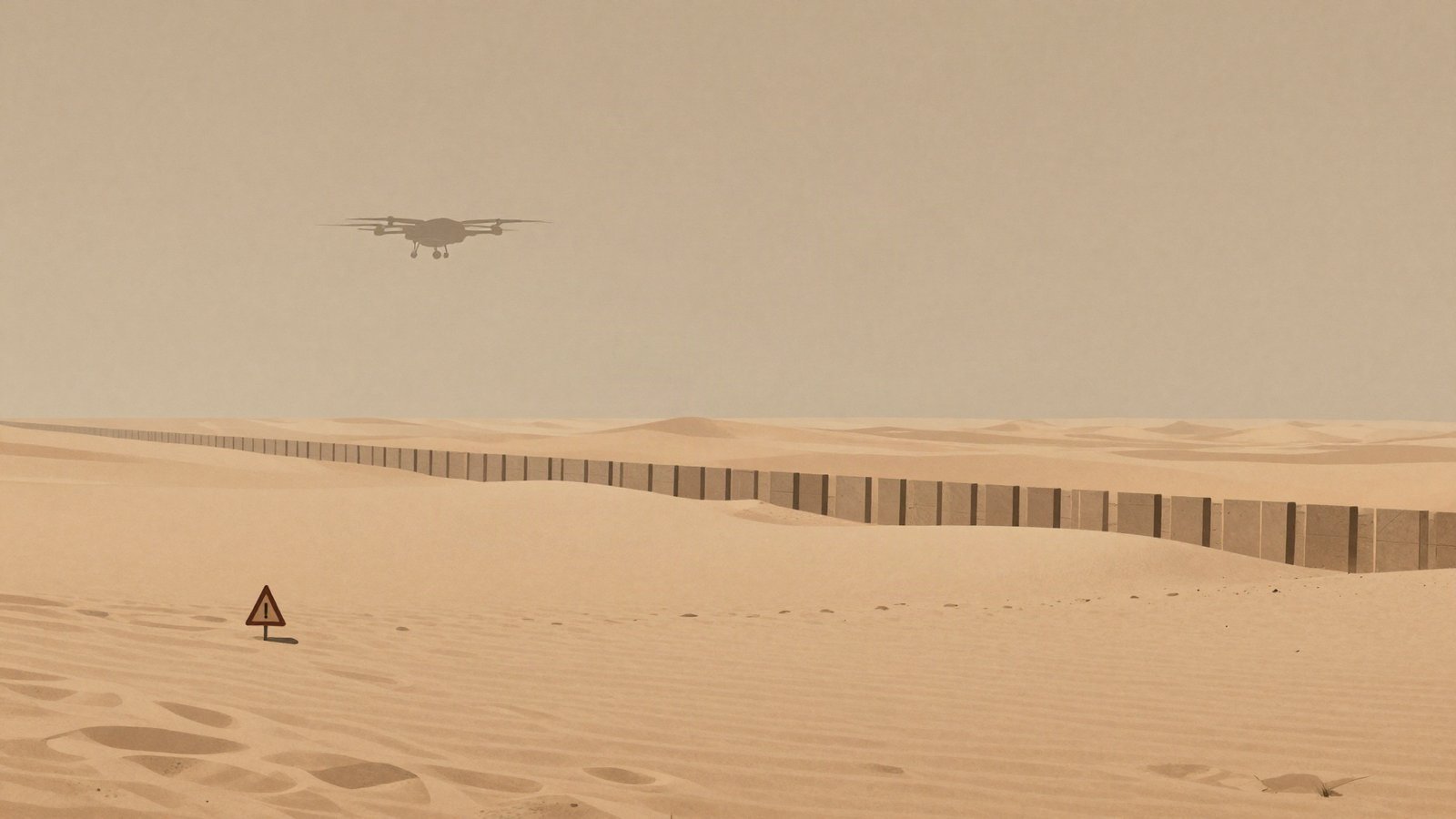
The long-running dispute over Western Sahara has continued to play out on two fronts at once. One is a low-intensity military confrontation along the desert barrier known as the Berm. The other is a diplomatic contest over recognition and the territory's future status. According to the reporting available, Polisario accused Morocco of carrying out drone and artillery attacks on civilians. Morocco, meanwhile, gained new diplomatic support for its autonomy plan.
These developments unfolded despite limited global attention to a conflict often overshadowed by larger crises. The claims made by each side reflect sharply opposed positions, and this article attributes them to their sources. Independent monitoring of the territory is constrained. That means many assertions about events on the ground cannot be verified from outside, including the reported civilian casualties.
Two fronts of a single dispute
The Berm is a lengthy sand barrier. It divides the areas controlled by Morocco from those held by the Polisario Front, which seeks independence for the territory it calls the Sahrawi Arab Democratic Republic. Reporting describes continued low-intensity strikes and military alerts around areas east and west of this barrier. That indicates the military dimension of the dispute remains active, even at a reduced tempo.
Alongside the fighting runs the diplomatic struggle. Morocco has pursued international backing for its plan to grant the territory autonomy under Moroccan sovereignty, and the reporting notes it gained new support for that approach. The principal actors in the dispute are Morocco, the Polisario Front, the self-declared Sahrawi Arab Democratic Republic, the UN mission MINURSO and Algeria. The last has long been associated with the Polisario cause.
Competing claims and language
The two sides describe the same territory in incompatible terms. Polisario characterised the reported attacks as aggression, framing the conflict as one of resistance against an occupying power. Morocco presents the territory as its southern provinces. It advances autonomy under its sovereignty as the basis for a settlement. The vocabulary each uses is itself part of the dispute, encoding rival claims to legitimacy.
This divergence extends to the international arena. There, major powers differ on whether the territory's future should be decided through self-determination or through autonomy within Morocco. That split among influential states helps explain why the dispute has resisted resolution for so long. It also explains why diplomatic recognition has become a battleground in its own right, pursued alongside the military standoff.
The dispute is among the longest-running on the international agenda. It has outlasted many attempts at mediation and several shifts in the wider diplomatic landscape. A ceasefire held for years before giving way to the current low-intensity pattern, and the territory's status remains formally unresolved. That longevity shapes how the parties approach the conflict. Each appears to calculate that time may work in its favour, whether through changes in international recognition or through facts established on the ground. The result is a standoff that resists both resolution and full-scale escalation.
The situation for Sahrawi civilians
For Sahrawi civilians, the reporting describes a set of everyday hazards. These include the risk of mines, restricted movement, displacement and limited independent monitoring of their circumstances. Landmines are a particular danger in a territory divided by a fortified barrier and marked by decades of conflict. They pose a lasting threat to those who live and move near contested zones.
The limited independent monitoring is significant beyond the immediate safety concerns. It means the conditions civilians face, and the competing claims about attacks, are difficult to assess from the outside. Restricted movement compounds the isolation. Displacement continues to affect Sahrawi communities, some of whom have lived in exile for many years. The scarcity of verification leaves much of the human picture obscured.
Diplomacy and the search for a settlement
The United Nations envoy continues to pursue negotiations aimed at a settlement, according to the reporting. The effort works within a framework complicated by the divergent positions of major powers. MINURSO, the UN mission on the ground, remains a reference point for reports on conditions in the territory. Its ability to monitor is one of the issues at stake.
The diplomatic effort proceeds against the backdrop of Morocco's growing support for its autonomy plan and Polisario's insistence on self-determination. With influential states divided, the envoy's task is to find common ground between positions that have proved durable and difficult to bridge. The reporting does not indicate a breakthrough. It describes instead a continuation of the parallel military and diplomatic tracks.
Escalation risks and what to watch
Observers warn that a combination of drone strikes and diplomatic hardening could foreclose the prospects for a negotiated settlement. If military incidents intensify while positions harden internationally, the space for compromise could narrow. That would entrench the dispute further rather than moving it toward resolution.
Analysts point to several indicators worth following. These include the content of MINURSO reports, the language adopted by the UN Security Council on the issue and any incidents occurring near civilian routes. Each would signal whether the dispute is drifting toward escalation or holding at its current low intensity. For now, the reporting describes a conflict that persists on two fronts, largely out of the international spotlight, with a settlement still elusive.
Sources
- Polisario letter to Security Council
- FCDO - Western Sahara travel advice
- El Pais - Polisario negotiations and drone escalation
You may also like to read
Drone Strikes and Fano Fighting Continue Across Ethiopia's Amhara Region
New monitoring points to ongoing drone operations, casualties and telecom restrictions in Amhara, as the government and rights advocates give differing accounts.
Cabo Delgado Attacks Displace Tens of Thousands as Insurgency Spreads to New Districts
Renewed assaults in northern Mozambique uprooted tens of thousands between May and July, testing gains that government and allied forces had claimed in the region.
Darfur Atrocities and El Fasher Control Keep Genocide Warnings at the Centre of Sudan's War
Reports of killings, displacement and blocked aid around El Fasher keep accountability and genocide warnings at the heart of concern over Sudan's war.
DR Congo faces the fastest Ebola outbreak on record as deaths pass 1,000
The Bundibugyo strain has spread faster than any previous Ebola epidemic, with no approved vaccine, as conflict and mistrust hamper the response.