Walmart Will Accept Apple Pay and Google Pay From 24 August, Ending a Decade of Resistance
Tap to Pay reaches every US Walmart and Sam's Club by the end of 2026, retiring one of the last major holdouts against contactless wallets.
Commentary & Analysis ·
Verified key facts
- Walmart and Sam's Club locations nationwide begin deploying standard Tap to Pay from 24 August, according to TechCrunch.
- Contactless payment will reach all US Walmart stores and Sam's Clubs by the end of 2026, with fuel stations following by mid-2027, Axios reported.
- Customers will be able to pay with contactless cards, phones or smartwatches, and to add eligible Walmart, Sam's Club and OnePay cards to digital wallets, per MacRumors.
- Cash, chip cards, Walmart Pay and Sam's Club Scan & Go remain available alongside the new option, according to Quartz.
- Walmart had declined to support Apple Pay for around a decade in favour of its own Walmart Pay and Scan & Go systems.
- Apple Pay is now accepted at about 85% of US retailers, a figure cited by Gadget Review in its account of the change.
The last big holdout gives way
Walmart will start accepting Apple Pay, Google Pay and other contactless wallets in its US stores from 24 August, ending roughly a decade of deliberate refusal. TechCrunch reported that Walmart and Sam's Club locations nationwide begin deploying standard Tap to Pay from that date, and Axios put full US coverage of both chains by the end of 2026, with fuel stations following by mid-2027.
The change is technically unremarkable and commercially significant. Contactless terminals have been standard hardware for years; what has been missing at Walmart is the decision to switch the capability on.
What shoppers will actually be able to do
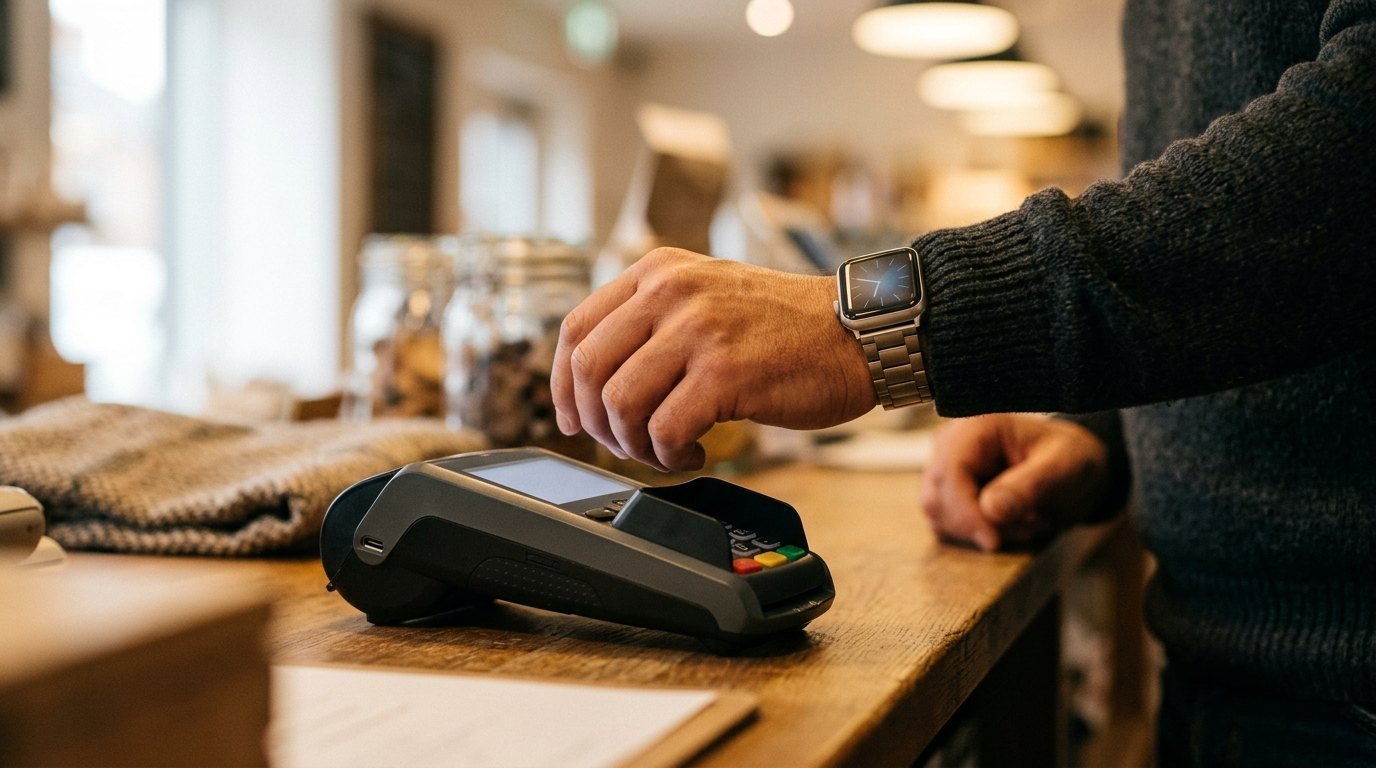
From the rollout date, customers will be able to pay with contactless cards, phones or smartwatches at the terminal, MacRumors reported. Eligible Walmart, Sam's Club and OnePay cards can be loaded into digital wallets, which means the retailer's own credit products travel inside Apple Wallet and Google Wallet rather than requiring a separate app.
Nothing is being taken away. Quartz reported that cash, chip cards, Walmart Pay and Sam's Club Scan & Go all remain available. For most shoppers the practical difference is the removal of a step: no opening an app, no scanning a QR code at the till.
CBS News reported that the rollout covers the full range of contactless credentials rather than a subset, which matters because partial support has been a recurring source of confusion at other retailers. A terminal that accepts a phone but not a watch, or one wallet but not another, generates exactly the friction the change is meant to remove.
Why Walmart resisted for so long
The refusal was strategic, not technical. Walmart built Walmart Pay and Sam's Club Scan & Go to keep the payment relationship, and the data attached to it, inside its own systems rather than inside Apple's or Google's. The retailer was also a founding participant in earlier merchant-led payment consortia that were explicitly designed to keep the phone makers out of the checkout.
That position rested on a bet that scale would let Walmart set the terms. Apple Pay is now accepted at about 85% of US retailers, a figure cited by Gadget Review, and the bet has visibly not paid off.
What changed the calculation
Two pressures converged. Customer complaints about the missing option had become a persistent theme, and the friction of an app-based flow looks worse each year as tapping becomes reflexive everywhere else. Android Central framed the change as an overdue concession to how people already pay.
The second pressure is OnePay, the financial services venture Walmart backs. A card product that cannot sit in a customer's default wallet is a card product that will not be used away from Walmart, which limits its value precisely where a consumer finance business needs to grow.
There is a generational argument as well. Shoppers who have never carried a physical card in the first place treat a store that cannot take a phone as a store that cannot take payment, and the share of transactions initiated from a device rather than a wallet has risen steadily every year the policy stood.
What Apple and Google get
For Apple, the addition of the largest US retailer closes the most conspicuous gap in Apple Pay's domestic coverage and removes the standard rebuttal to any claim of ubiquity. For Google, the win is smaller in symbolism and similar in substance, since Android shoppers face the same checkout.
Neither company gains a large new revenue stream directly, because interchange economics on wallet transactions are thin. What they gain is the removal of an exception that gave other large merchants cover to hold out.
The strategic value is habit. Every additional place a wallet works makes the phone the default instrument rather than the fallback, and the merchants still refusing contactless payment are now a short and shrinking list with no obvious champion left at the top of it.
The awkward position of Walmart Pay
Walmart has kept its own payment app alive alongside the new option, but the logic that sustained it is gone. An app that exists to substitute for a wallet the store now accepts has to justify itself on features rather than necessity, and the obvious candidates are receipts, returns and loyalty rather than payment itself.
Scan & Go at Sam's Club is in a stronger position, since it replaces the queue rather than the card, and the club format gives it a function that tapping at a till does not.
Retaining both systems also has a cost. Every additional payment path at the till is another route for staff to be trained on and another set of edge cases in returns and refunds, which is one reason retailers eventually consolidate on the method most customers actually use.
The end-of-2026 coverage target
The measurable commitment is the schedule: every US Walmart store and Sam's Club by the end of this year, and fuel stations by the middle of next. Walmart operates several thousand US locations, so the rollout is a substantial field-services exercise even where terminals are already capable.
Whether that deadline holds is the test of how seriously the company now takes the change. A slipped date would suggest the reversal was a concession made under pressure; hitting it would suggest Walmart has decided the payment relationship it defended for a decade was never worth the friction it cost.
Sources
- TechCrunch - Walmart to finally start accepting Apple Pay and Google Pay
- Axios - Walmart is adding tap-to-pay options like Apple Pay, Google Pay
- MacRumors - Walmart to Begin Accepting Apple Pay in U.S. Stores
- Quartz - Walmart to accept Apple Pay and Google Pay at all U.S. stores
- Android Central - Google Pay and Apple Pay are finally coming to Walmart
You may also like to read
Apple Is Negotiating Nine-Figure News Deals to Feed Its Gemini-Powered Siri
The company has proposed paying publishers each time their reporting is used, a departure from the fixed licence fees that have defined AI content deals.

Apple Intelligence cleared for China launch as regulator approves Alibaba-powered AI
China's cyberspace regulator has registered Apple's generative AI service, ending a 22-month wait and clearing iPhone AI features built on Alibaba's Qwen models.

Tesla Quietly Discontinues the Solar Roof, a Decade After Elon Musk Unveiled It
The tile product has been pulled from Tesla's website and from installer supply, with the company concluding it was not financially viable.
Marvell Hands Google an Option on $12.2 Billion of Its Own Shares in an Expanded Custom-Chip Deal
The warrant vests against purchasing milestones running to fiscal 2033 and could be worth around $120 billion in chip orders to Marvell.