US Helicopter Disables Cargo Ship Accused of Running the Iran Blockade, as Threat Reports Shadow the President's NATO Trip
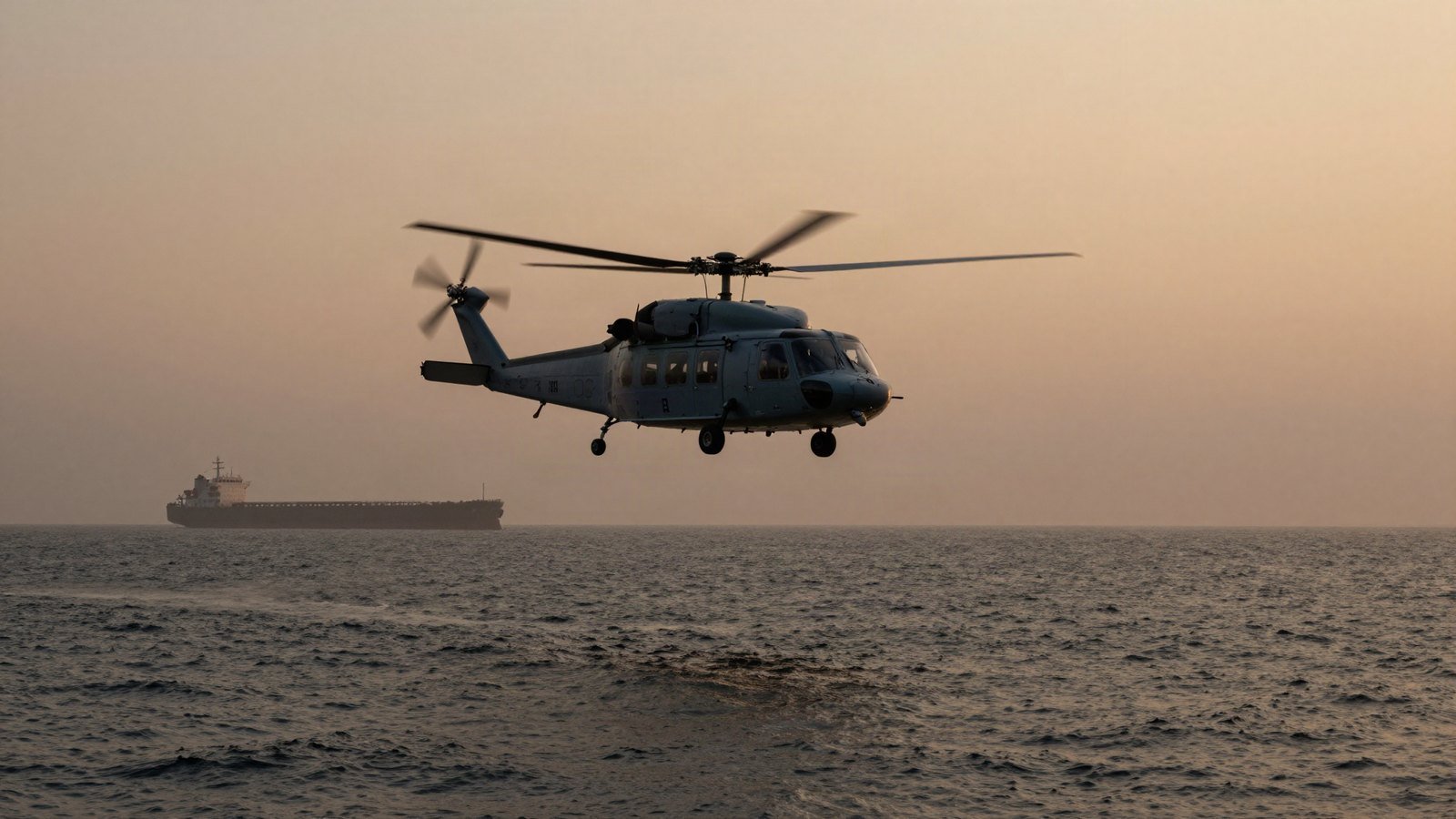
The US military said a Navy MH-60 fired Hellfire missiles to disable a Panama-flagged ship's steering after repeated warnings, one of several signs of how far the confrontation with Iran now reaches, from shipping lanes to presidential security.
Commentary & Analysis ·
Verified key facts
- The US military said a Navy MH-60 helicopter fired two Hellfire missiles to disable the steering gear of a Panama-flagged cargo ship that ignored repeated warnings to stop while violating the naval blockade on Iranian ports, per Just Security's 12 August round-up.
- The blockade is part of ongoing US military operations against Iran that have kept carrier assets, including USS Abraham Lincoln, deployed in the region for months.
- Separately, multiple outlets reported that a credible Iranian threat led President Trump to switch aircraft covertly when departing a NATO summit in Turkey, leaving Air Force One on a different flight.
- Reports cited intelligence about a possible missile threat to Air Force One and a person near the summit possessing a shoulder-fired missile.
- The disabled vessel's cargo, ownership and the fate of its crew were not detailed in initial military statements.
A warning shot that was not a warning
The US military's confrontation with Iran produced a stark illustration of its rules of engagement this week: a Navy MH-60 helicopter fired two Hellfire missiles into the steering gear of a Panama-flagged cargo ship, disabling the vessel after it ignored repeated orders to stop. The military said the ship was violating the naval blockade on Iranian ports, according to the incident summary carried in Just Security's daily security round-up on 12 August.
Disabling fire against a merchant vessel is a significant escalation point in any maritime enforcement campaign. It says the blockade is not rhetorical, and that the cost of testing it is now measured in Hellfires rather than paperwork.
How a blockade actually works
A naval blockade lives or dies on enforcement. Shippers, insurers and flag states watch every interception to calibrate the real risk of a run, and a single disabled vessel changes those calculations across the market. The targeting of steering gear, rather than the hull or superstructure, follows the established pattern for graduated force: stop the ship, spare the crew.
What happens next to the vessel, boarding, seizure, or escorted diversion, was not detailed in the initial statements, and neither were its cargo or ownership. Those details matter for the legal record; blockade enforcement is among the most scrutinised acts in the law of armed conflict.
The threat that followed the president home
The same confrontation reached into presidential security this week. Multiple outlets, including the New Republic, reported that President Trump covertly switched aircraft while departing a NATO summit in Turkey after US authorities received intelligence of an Iranian threat, described in the reporting as including a possible missile threat to Air Force One and a person near the summit in possession of a shoulder-fired missile.
Accounts describe the president leaving the summit concealed in a catering vehicle and departing on a military aircraft while Air Force One flew separately. The White House has characterised the arrangements only as a separate flight, and the specifics rest on the cited reporting rather than official confirmation.
Reading the two events together
One incident is maritime enforcement, the other protective security, but they describe the same conflict at different altitudes. The blockade squeezes Iran's ports; the threat reporting, if accurate, shows Tehran's reach being taken seriously at the level of the president's own aircraft.
Neither side currently shows an off-ramp. The blockade's continuation requires sustained naval presence, the cost of which is visible in the extended carrier deployments already straining crews, and Iran's capacity to threaten asymmetrically, from shipping to security plots, is precisely what makes the confrontation durable.
The risks in the shipping lanes
For the commercial world, the immediate concern is precedent. Panama's registry flags a vast share of global tonnage, and a Panama-flagged vessel disabled by US fire will echo through flag-state politics and marine insurance pricing regardless of the ship's actual business.
Rates for regional transits have already lived through years of Red Sea disruption; a shooting enforcement regime around Iranian ports adds another premium. The market's response, rerouting, war-risk surcharges, or quiet withdrawal from the trade, will be measurable within weeks.
The legal architecture of a blockade
Blockade is a term of art in the law of naval warfare, carrying formal requirements: declaration, notification, effectiveness and impartial enforcement. Whether the US operation against Iranian ports meets each element is the kind of question that occupies legal advisers precisely because the label triggers belligerent rights, including the right to stop, visit and, after warning, disable vessels that run it.
The choice of disabling fire against steering gear, rather than boarding first, sits within that graduated-force doctrine, but each such incident becomes a data point other navies study. Precedents set in this campaign will be cited in future crises in other waters, which is why maritime lawyers read these engagement reports as closely as admirals.
Panama's uncomfortable position
The vessel's Panama flag matters beyond paperwork. Panama operates the world's largest ship registry, an open register whose flag flies over a substantial share of global tonnage, and its response to a US strike on one of its flagged vessels involves genuine diplomatic balancing between registry customers and its relationship with Washington.
Flag states rarely escalate such incidents, but registries feel commercial pressure when their flag becomes associated with enforcement risk. Shipowners in sanctioned trades have historically migrated toward registries perceived as safer, and insurers reprice accordingly, one more channel through which a single helicopter engagement moves markets.
Three threads worth following
Three threads deserve attention: whether the disabled ship's ownership and cargo are disclosed, whether Iran retaliates against shipping or US assets in response, and whether the reported Air Force One threat produces any public investigative follow-up.
Each would sharpen the picture of a confrontation that has settled into a grinding, multi-domain standoff, one enforced at sea, defended in the air, and paid for by crews and markets far from either capital.
Sources
- Just Security - Early Edition, August 12, 2026
- The New Republic - Decoy plane report from NATO summit
- AOL/Irish Star - Air Force One aircraft switch accounts
- NCRI - Iran news round-up
You may also like to read

Analysts Say Iran Is Setting the Tempo in a Prolonged War With the United States
Analysts describe Tehran using regional disruption and endurance, not a single decisive battle, to shape US choices, as mediators keep searching for an off-ramp.
US-Saudi Strikes on Iran-Backed Militias Put Iraqi Sovereignty Under New Pressure
The first acknowledged joint US-Saudi strikes on Iran-linked militias in Iraq widened the war and angered Baghdad, which said it had no prior knowledge of them.
US strikes on Iran continue as interim truce collapses over Hormuz dispute
US bombing has entered a third week after a June memorandum broke down. Washington and Tehran blame each other as the Strait of Hormuz stays contested.

Iraq's Government Faces a Militia Disarmament Test as the Regional War Spills Across Its Territory
Foreign strikes and militia drone attacks pressed Baghdad to assert control, as some Popular Mobilization factions weighed disarmament while others firmly refused.