Iraq's Government Faces a Militia Disarmament Test as the Regional War Spills Across Its Territory
Foreign strikes and militia drone attacks pressed Baghdad to assert control, as some Popular Mobilization factions weighed disarmament while others firmly refused.
Commentary & Analysis ·
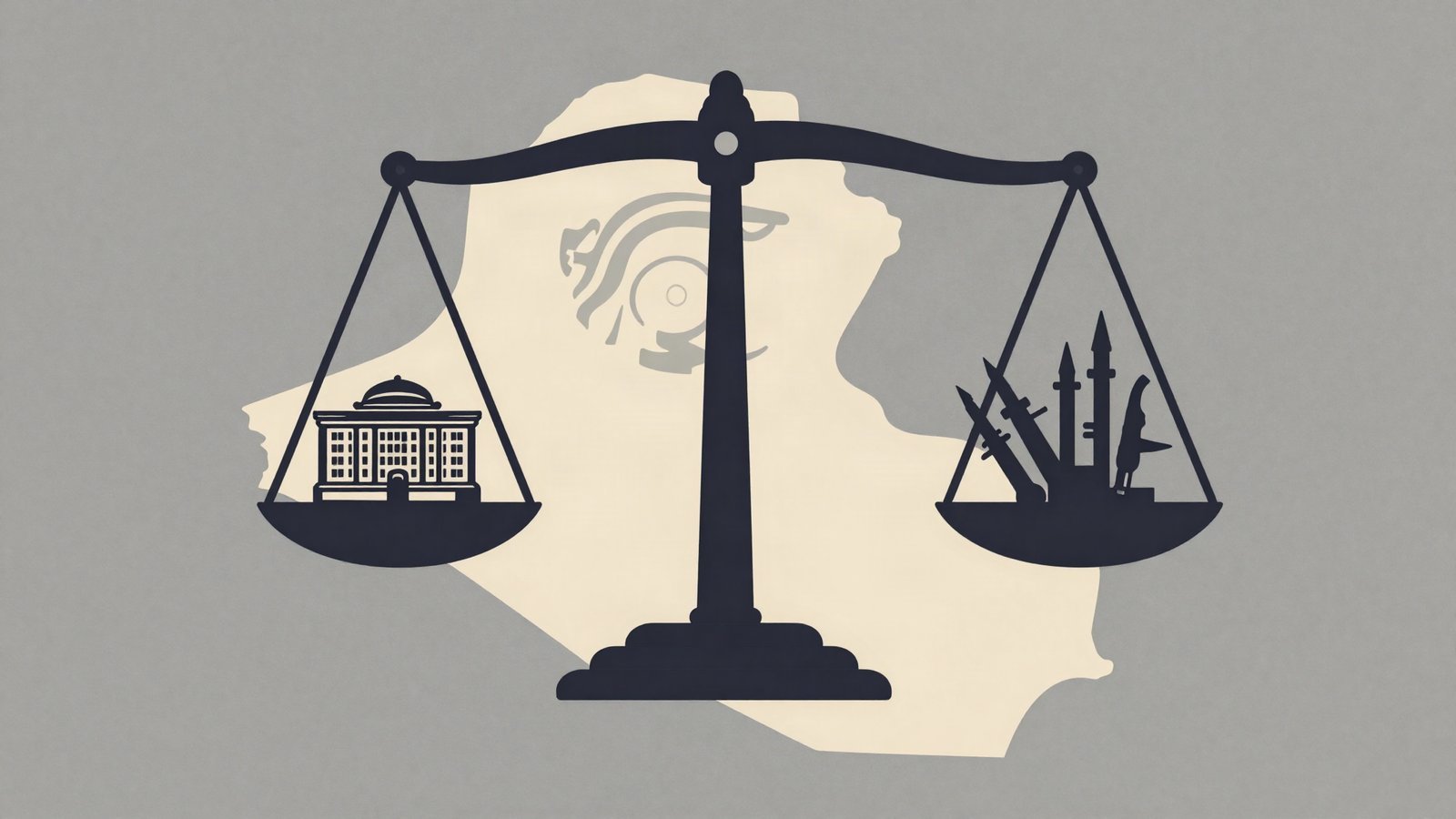
Verified key facts
- Foreign strikes and militia drone attacks intensified pressure on Baghdad to assert control, according to the reporting.
- Some Popular Mobilization factions have discussed handing weapons to the state; others reject disarmament.
- Baghdad condemned unauthorised foreign strikes and called for respect for its sovereignty.
- The government pursued new security cooperation and anti-corruption measures amid the pressure.
- Analysts warn a weak state monopoly on force could allow escalation beyond government control.
A state under pressure from several sides
Iraq's government finds itself squeezed as the regional war reaches its territory. According to the reporting, strikes by foreign powers and drone attacks by militias have intensified pressure on Baghdad to assert control. The state faces demands to act, yet the levers available to it are limited.
At the centre of the challenge lies the question of armed groups. Some Popular Mobilization factions have discussed handing their weapons to the state, according to available reporting. Others reject disarmament outright and continue what they describe as resistance activity. The split leaves the government managing a divided armed landscape.
The disarmament question
The debate over disarmament goes to the heart of the Iraqi state's authority. A government's ability to hold a monopoly on the use of force is a basic marker of sovereignty. In Iraq, that monopoly is contested by factions with their own weapons and agendas.
The willingness of some factions to discuss handing over weapons offers a potential path toward greater state control. Yet the refusal of others complicates any uniform approach. The main parties are the Iraqi government, Popular Mobilization Forces factions, Iran, the United States and Saudi Arabia, each with a stake in the outcome.
Disarmament in such settings is rarely a simple transaction. Armed groups often view their weapons as sources of influence, protection and standing, and they may resist giving them up without guarantees. Governments, for their part, must offer credible assurances and alternatives if they hope to persuade factions to disarm. The process tends to unfold slowly, through negotiation as much as decree. Iraq's experience reflects that difficulty.
What Baghdad has tried to do
The government has not been passive. According to the reporting, it pursued new security cooperation and anti-corruption measures. It did so while facing attacks launched from or against Iraqi territory, a difficult environment for reform.
Security cooperation can strengthen the state's capacity to manage armed groups and respond to threats. Anti-corruption measures address a longstanding source of public frustration and institutional weakness. Pursued together, they represent an effort to build the authority needed to assert control, even as violence continues around them.
Condemnation and conflicting claims
The official response to the strikes was firm. Baghdad condemned unauthorised foreign strikes and called for respect for its sovereignty. The government's position was that no outside power should strike its territory without consent.
The militia factions, by contrast, issued conflicting statements on disarmament. Some signalled openness to handing over weapons, while others rejected the idea. These divergent messages, coming from different armed groups, reflect competing visions of the factions' role and their relationship to the state.
The mixed signals make it harder for the government to craft a single policy. They also complicate outside assessments of how much control Baghdad can realistically expect to achieve.
The burden on ordinary Iraqis
The pressures on the state translate into risks for its people. According to contemporaneous reporting, Iraqis face renewed insecurity, damaged infrastructure and the danger that political disputes turn violent. These outcomes touch daily life directly.
Insecurity disrupts routines and raises fear. Damaged infrastructure can affect essential services. When political disputes spill into violence, ordinary people are often caught in the consequences. For a population that has endured earlier periods of conflict, the renewed strain is a heavy weight.
Balancing rival partners
Iraq's foreign relationships add another layer of difficulty. According to published reporting, the government is balancing ties with Washington, Tehran, Riyadh and Kurdish authorities. These relationships do not always align, and some pull in opposite directions.
Maintaining cooperation with the United States while preserving ties to Iran is a persistent challenge, especially amid a conflict involving both. Adding Saudi Arabia and Kurdish authorities to the equation multiplies the competing demands. The government must navigate among partners whose interests frequently clash.
Kurdish authorities in the north add a further internal dimension, since they administer their own region and maintain distinct relationships with outside powers. Coordinating security and politics across these lines requires constant negotiation. When a regional war raises tensions, those internal balances become harder to hold. The government's task is to keep the various centres of power aligned enough to prevent fragmentation.
The danger of a weak monopoly on force
Independent analystsing pointed to a central risk. A weak state monopoly on force, they warned, could allow escalation beyond government control. If armed groups act independently, the government may struggle to prevent actions that draw the country deeper into conflict.
The concern is concrete rather than abstract. A drone attack launched by a single faction, for instance, could invite retaliation that Baghdad neither sanctioned nor foresaw. Such an incident could pull the state into a confrontation it had tried to avoid. That gap between the government's authority and events on the ground is precisely what worries analysts. Closing it is central to any hope of keeping Iraq out of the war's core.
Several indicators will show how the situation develops. Legislation on armed groups could clarify the legal framework for disarmament. Changes in Popular Mobilization Forces command structures would signal shifts in control. US security arrangements and the degree of militia compliance will further reveal whether Baghdad can assert the authority the moment demands.
Sources
- CFR - Instability in Iraq
- ACLED - Middle East overview July 2026
- CRS - Iraq update
You may also like to read
US-Saudi Strikes on Iran-Backed Militias Put Iraqi Sovereignty Under New Pressure
The first acknowledged joint US-Saudi strikes on Iran-linked militias in Iraq widened the war and angered Baghdad, which said it had no prior knowledge of them.

Analysts Say Iran Is Setting the Tempo in a Prolonged War With the United States
Analysts describe Tehran using regional disruption and endurance, not a single decisive battle, to shape US choices, as mediators keep searching for an off-ramp.

US strikes on Iran continue as interim truce collapses over Hormuz dispute
US bombing has entered a third week after a June memorandum broke down. Washington and Tehran blame each other as the Strait of Hormuz stays contested.

US Launches New Strikes on Iranian Targets After Attack on American Forces
The US struck Iranian targets after saying its forces in Jordan were attacked, as President Trump promised retaliation and Iran vowed to answer the strikes.