America's Summer of Flight Disruption Deepens, With Storms, Staffing Gaps and Rebooking Waits Stretching to Three Days
Nearly 10,000 US flights were delayed in a single day this week, and thinner airline schedules mean cancelled passengers can wait days for a seat.
Commentary & Analysis ·
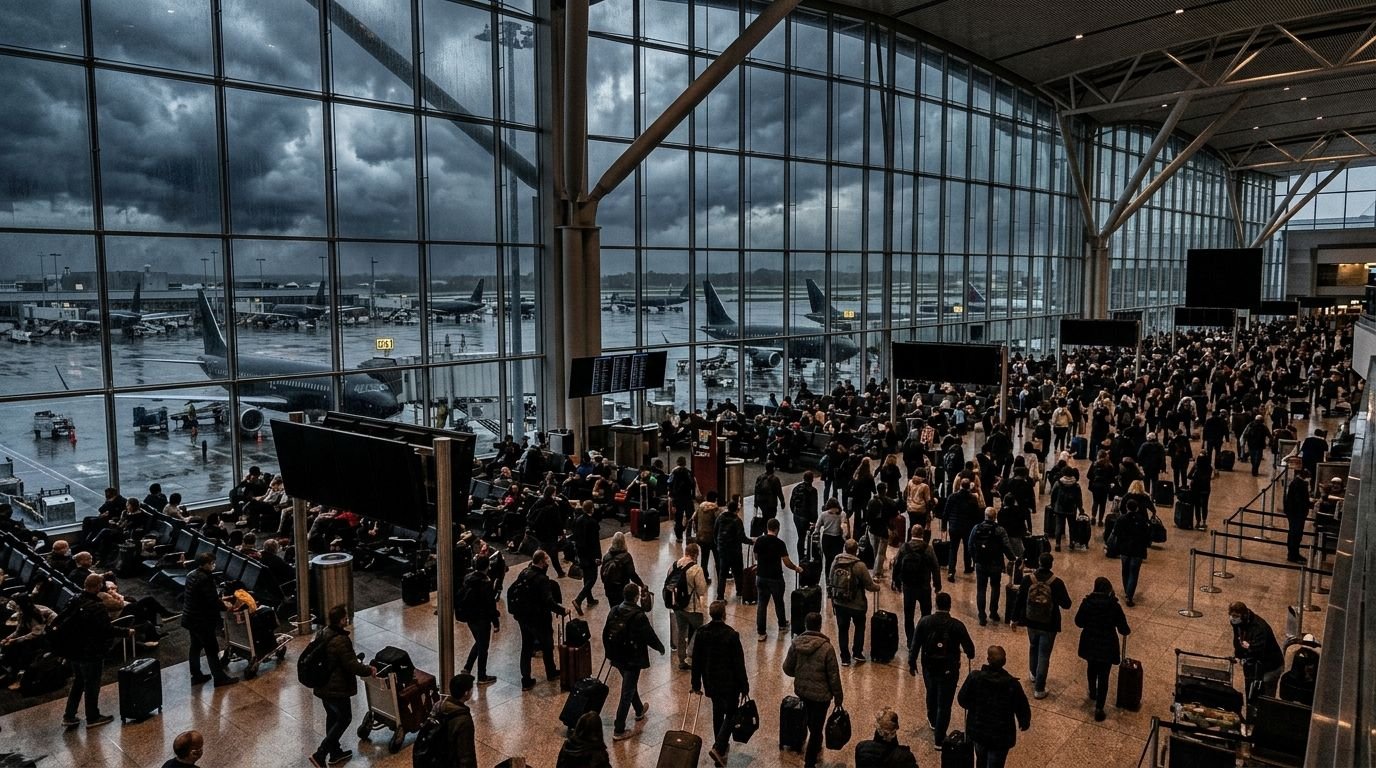
Verified key facts
- 9,641 flights within, into or out of the US were delayed and 455 cancelled on Sunday 16 August, per Travel Tomorrow, with 7,409 delays on Monday
- More than 820 flights were delayed and 50 cancelled on Tuesday as disruptions continued, NJ.com reported
- Axios reported disruptions are mounting from the combination of extreme weather and air traffic controller staffing shortages
- The Washington Post reported cancelled passengers are being rebooked onto flights up to three days later because airlines have cut spare capacity
- FAA restrictions at Chicago O'Hare cut landing capacity for hours at a time during thunderstorms, per Indian Eagle's disruption tracking
- TSA staffing shortages have lengthened security lines at multiple airports, The Travel reported
A system running with no slack
American air travel is enduring one of its roughest stretches of the summer, and the numbers describe a system with no cushion left. On Sunday 16 August, 9,641 flights within, into or out of the United States were delayed and 455 were cancelled, according to figures compiled by Travel Tomorrow. Monday brought 7,409 more delays, and by Tuesday NJ.com was reporting a further 820-plus delays and 50 cancellations as the disruption rolled into a new week.
Axios reported that the disruptions are mounting from a combination of extreme weather and staffing shortages, twin pressures that have converged at the peak of the summer travel season. Neither pressure is new on its own; what distinguishes this stretch is that both have arrived at once, in the very weeks when the system runs closest to its ceiling and has the least room to recover from any shock.
The weather half of the problem
Slow-moving summer storm systems have been battering the country's busiest hubs. Thunderstorms and strong winds at Chicago O'Hare have repeatedly forced Federal Aviation Administration flow restrictions that reduce landing capacity for hours at a time, per Indian Eagle's tracking of the disruption. Low cloud and reduced visibility have compounded the problem along the East Coast corridor.
Weather delays cascade in a way passengers rarely see: an aircraft held out of O'Hare at noon misses its next two rotations, and by evening the delay has propagated to airports where skies are clear. With load factors at summer peaks, there are no spare aircraft to absorb the ripple.
The staffing half
The FAA's operational advisories increasingly cite air traffic controller staffing shortages alongside weather as reasons to limit how many flights the system can handle, Travel Tomorrow reported. Controller shortfalls that were once an occasional footnote have become a standing constraint at key facilities.
On the ground, the Transportation Security Administration has reported staffing gaps at multiple airports amid labour disruptions, producing longer security lines, slower processing and missed departures, according to The Travel. When security queues stretch past an hour, airlines face a choice between holding aircraft and stranding passengers, and either answer generates more delay.
Why a cancellation now costs you three days
The sharpest change for travellers is not the delay itself but what happens after a cancellation. The Washington Post reported that passengers whose flights are scrapped are increasingly being rebooked onto services departing up to three days later, because airlines have trimmed capacity and the remaining flights are already close to full.
Carriers cut schedules as rising fuel costs squeezed their operations, leaving fewer spare seats to reaccommodate disrupted passengers, per the Post's analysis. A decade ago a cancelled flight usually meant the next departure; in August 2026 it can mean a long weekend in an airport hotel at the traveller's own arrangement.
What passengers can actually do
The practical defences are unglamorous but effective. Booking the first departure of the day dramatically improves the odds of arriving, because morning aircraft have not yet inherited the previous day's cascading delays. Nonstop routings remove the connection risk that multiplies during flow-control days.
Travellers connecting through storm-prone hubs should treat minimum connection times as fiction in August and build in margin. And when a cancellation does land, rebooking through the airline's app while queueing for an agent, a both-channels approach, consistently beats either alone. Carrying on rather than checking luggage preserves the flexibility to accept whatever seat appears, since a checked bag ties the passenger to the airline's own recovery timeline rather than their own.
Nine airports throttled in a single stretch
The clearest measure of how stretched the system has become came when the Federal Aviation Administration temporarily cut service rates at nine major US airports over a combination of weather and equipment outages, as nationwide cancellations approached the 2,000 mark across the disrupted stretch, The Travel reported. Ground delay programmes of that breadth are normally reserved for hurricane landfalls, not a routine week of summer convection.
Equipment adds a third pressure alongside weather and staffing. Ageing radar, radio and flow-management systems have produced outage-driven slowdowns at individual facilities through the summer, and each one forces controllers to space aircraft further apart, cutting an airport's hourly capacity even under clear skies.
What US passengers are owed, and what they are not
American consumer rules remain narrower than many travellers assume. A passenger whose flight is cancelled for any reason is entitled to a full cash refund if they choose not to travel, including for refused ancillary fees, but United States regulations require no cash compensation for the delay itself, in contrast to the European Union's EU261 regime.
Meal vouchers, hotel rooms and rebooking on rival carriers are matters of individual airline policy, published in each carrier's customer service plan, and those commitments generally apply to controllable disruptions such as crew shortages rather than weather. In a week where weather and staffing intertwine, airlines classify generously in their own favour, which is one more reason the morning's first departure remains the cheapest insurance available.
The autumn schedule cuts that will decide next summer
Relief, when it comes, will arrive with the September schedule change, when leisure demand ebbs and airlines retire their most fragile summer rotations. The deeper question is whether carriers rebuild spare capacity into next year's schedules or bank the savings and accept that disruption recovery now takes days.
The controller pipeline sets the longer clock: training a certified professional controller takes years, so the staffing constraint the FAA is citing this week will still bind next summer. Until then, the system's margin for error is the weather's to spend.
Sources
- The Washington Post - Your flight is canceled. Here's why the new one is in three days.
- Axios - Air travel disruptions mount amid extreme weather, staffing shortages
- NJ.com - Over 820 flights delayed, 50 canceled amid widespread U.S. travel disruptions
- Travel Tomorrow - US aviation industry hit by cancellations and delays due to severe weather
- The Travel - U.S. Airports Face Cancellations And Grounded Flights As Staff Skip Work Amid Severe Weather
- Indian Eagle - US Flight Disruptions in 2026: What's Really Happening
You may also like to read
Europe's Summer of Discontent: Overtourism Protests Spread as Cities Impose New Limits
Anti-tourism demonstrations have swept more than 40 Spanish cities and spread across Europe, as Venice, Barcelona, Nice and Cannes tighten rules on visitors.

Chick-fil-A Turns Chicken and Waffles Into a Sandwich, Nationwide From August 24
The chain's autumn line-up pairs maple waffles, bacon and honey butter in breakfast and entree sandwiches, joined by s'mores-flavoured shakes and frosted coffee, after a 2025 regional test earned a national rollout.

The Perseids Peak Under a New Moon, and the Sky Put On Its Best Show in Years
With no moonlight to wash them out, this year's Perseid meteor shower delivered rates of 50 to 75 meteors an hour at dark sites on the night of 12-13 August, on the same date as Europe's total solar eclipse.
At the Singapore Food Festival, hawker heritage takes centre stage over fine dining
The Singapore Food Festival returns from 10 to 26 July 2026, putting hawker heritage, night noodle markets and young chefs at the heart of the city.