Ukrainian Drones Set Fire to the Novokuibyshevsk Refinery and an Ozon Warehouse in Samara Oblast
Overnight strikes 900km from the front line halted a Rosneft refinery and forced 500 workers out of Russia's second-largest online retailer's hub.
Commentary & Analysis ·
Verified key facts
- Drones struck the Novokuibyshevsk oil refinery in Russia's Samara Oblast overnight on 21-22 August, starting a fire, according to Ukrainska Pravda.
- The refinery, part of the Rosneft group, has a design capacity of about 8.8 million tonnes of crude a year and supplies fuel and lubricants used by Russian forces, the Kyiv Independent reported.
- An Ozon fulfilment complex at Chapayevsk was hit in the same wave; Ozon said more than 500 staff were evacuated within minutes and several people were injured.
- Samara Oblast governor Vyacheslav Fedorishchev said several dozen drones had been shot down or intercepted and confirmed damage at an industrial site.
- Both targets sit roughly 900km from the front line; Ukraine struck the Perm refinery, about 1,500km away, the previous day, per the Kyiv Independent.
- Russia's deputy foreign minister Sergey Ryabkov said this week that Moscow was ready to hear new ideas on ending the war provided they matched President Putin's position, Al Jazeera reported.
A long-range raid on the Volga
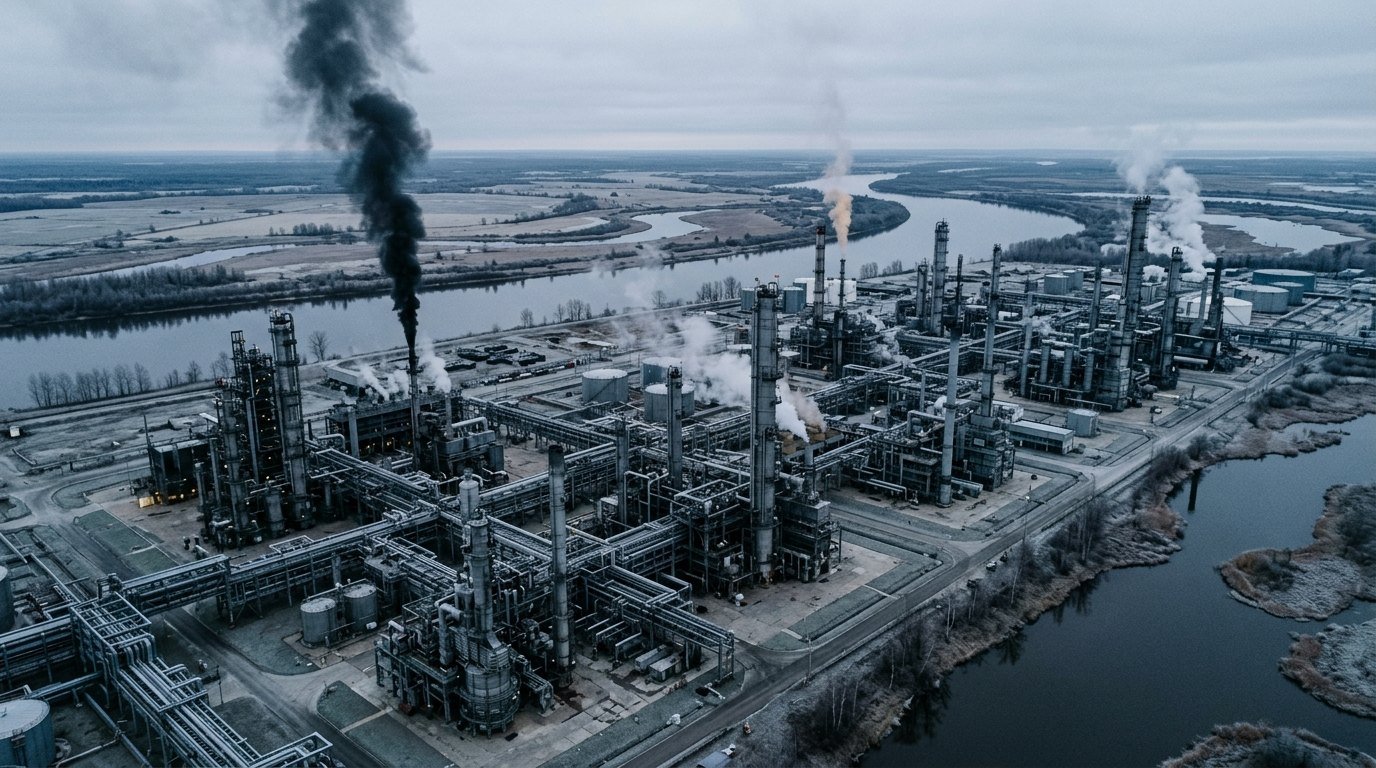
Ukrainian long-range drones struck two industrial sites in Russia's Samara Oblast in the early hours of Saturday, setting fire to an oil refinery that feeds the Russian military and forcing the mass evacuation of one of the largest warehouses in the Volga region. Ukrainska Pravda reported that the fire at the Novokuibyshevsk refinery began on the night of 21-22 August, after a wave of drones reached a region that lies roughly 900 kilometres from the nearest fighting.
Residents posted footage of thick black smoke rising above the plant, and the Kyiv Independent reported that Ukraine's General Staff described the strike as part of a continuing effort to disrupt Moscow's fuel supply. The attack came less than 24 hours after Ukrainian drones reached the Perm refinery, some 1,500 kilometres from the front, in what has become a steadily lengthening reach for Kyiv's deep-strike programme.
Why Novokuibyshevsk matters to the Russian army
The Novokuibyshevsk plant belongs to the Rosneft group and has a design capacity of about 8.8 million tonnes of crude a year, according to the Kyiv Independent. Its output is not simply commercial: the refinery produces fuels and lubricants that flow to Russian units, and the site has featured on Ukrainian target lists precisely because of that military dependency.
Refineries have become the most consequential target class in the war away from the trenches. They are large, fixed, flammable and, critically, hard to repair quickly when the specialist Western equipment inside them can no longer be legally imported. Each successful strike therefore removes capacity for weeks rather than hours, which is why Ukrainian commanders have persisted with the campaign even as air defences around such plants have thickened.
Samara Oblast has been hit before. The Moscow Times reported a Ukrainian drone attack on a petrochemical plant in the same region in June, and RFE/RL documented strikes on a Wildberries logistics hub there alongside a refinery in Saratov. What has changed is the frequency, and the willingness to strike two categories of target in a single night.
Five hundred people out of an Ozon hub in minutes
The second target was a fulfilment complex operated by Ozon, Russia's second-largest online marketplace, at Chapayevsk. The company said more than 500 employees were evacuated within minutes of the alert and that several people were injured, according to the Kyiv Independent. Operations at the site were halted.
The complex covers roughly 135,000 square metres and ranks among the biggest warehouse facilities in the Volga region. It is the first confirmed Ukrainian strike on an Ozon site; since mid-July, Ukrainian drones have repeatedly hit logistics centres belonging to Ozon's rival Wildberries, including a hub in the same oblast reported by RFE/RL. The pattern suggests Kyiv now treats civilian-branded distribution networks as part of the Russian military's rear-area logistics rather than as separate commercial infrastructure.
What the governor confirmed, and what he left out
Samara Oblast governor Vyacheslav Fedorishchev confirmed the attack on the Ozon site, saying that several dozen drones had been shot down or intercepted over the region and that people were receiving medical treatment after damage at an industrial facility. His statement, as reported by the Kyiv Independent, did not name the refinery.
That omission is now routine. Russian regional officials have settled into a standard formula in which the number of drones destroyed is publicised and the identity of anything hit is not, leaving refinery damage to be established from satellite imagery, flight-tracking of firefighting aircraft and the videos residents post before they are removed. Independent confirmation of the scale of the Novokuibyshevsk fire had not emerged by Saturday morning.
The gap between an official interception count and a confirmed strike is not a contradiction. Air defences can destroy most of an incoming wave and still fail, because a refinery only needs one drone to reach a distillation column or a pumping station to lose weeks of throughput. Counting interceptions therefore measures effort rather than outcome, which is precisely why it is the number regional administrations choose to publish.
A campaign measured in kilometres, not tonnes
The significance of the past 48 hours lies less in what burned than in where it burned. Perm sits east of the Urals. Samara is deep in the Volga basin. Neither is a border region, and neither can be defended by the dense air-defence belts that protect Moscow and the occupied territories.
Al Jazeera reported earlier in the week that Russia has been intensifying its own missile campaign against Ukrainian cities, describing what one analysis called an illusion of victory sustained by long-range fire. The Samara strikes are the mirror image of that logic: neither side can force a decision on the ground, so both are attempting to make the other's rear areas expensive.
Moscow's diplomatic signal, unchanged in substance
The strikes landed against a diplomatic backdrop that has not moved. Deputy foreign minister Sergey Ryabkov said this week that Moscow was ready to listen to new ideas for ending the war, provided they aligned with President Vladimir Putin's position and with what he called the realities on the ground, Al Jazeera reported.
That formulation concedes nothing. It invites proposals while pre-committing Russia to reject any that do not ratify its territorial position, and Putin has repeatedly declined to resume formal talks. For Kyiv, the practical consequence is that the pressure it can apply is the pressure it generates itself, which is what the deep-strike campaign is designed to do.
The repair window that will shape Russia's autumn fuel market
The number that will matter over the coming weeks is not the count of drones intercepted but the length of the outage at Novokuibyshevsk. A short shutdown for damage assessment is absorbed by the wider Rosneft system. A prolonged loss of 8.8 million tonnes of annual capacity, arriving alongside damage at Perm and earlier strikes in Krasnodar and Tatarstan, begins to show up as regional diesel shortages and export restrictions.
Russia has responded to previous rounds by curbing petrol exports to protect the domestic market. Whether that step is repeated before the autumn harvest and the start of the heating season is the clearest available measure of how much the Samara raid actually cost.
For Ozon, the equivalent measure is how quickly the Chapayevsk complex resumes dispatching. A logistics hub of 135,000 square metres does not have an obvious substitute in the Volga region, and a prolonged closure would push delivery times up across a large consumer market that has so far experienced the war mainly through prices rather than through availability.
Sources
- Ukrainska Pravda - Drone strike sparks fire at Novokuibyshevsk oil refinery in Russia's Samara Oblast
- Kyiv Independent - Major oil refinery, Ozon logistics center set ablaze in reported Ukrainian attack
- Kyiv Post - Drones Strike Novokuibyshevsk Refinery and Ozon Hub in Samara Region
- RFE/RL - Ukrainian Drones Strike Wildberries Hub In Samara Region, Saratov Refinery
- Al Jazeera - Russia says ready for 'new ideas' on Ukraine war that match Putin's goals
You may also like to read
Ukraine and Russia Trade Deadly Drone Strikes as the Air War Reaches Far Behind the Front
Long-range drone attacks struck Russian regions and Ukrainian cities in early August, both sides claiming military targets as casualty reports stayed unverified.

Ukraine and Russia trade long-range strikes as both sides report civilian deaths
Kyiv reported deadly Russian strikes on defence and residential sites, while Moscow said Ukrainian drones hit factories deep inside Russia.

EU adopts its 21st sanctions package against Russia, hitting energy, finance and crypto
The bloc froze the oil price cap for a year and tightened measures on LNG, banks and crypto, with parallel restrictions imposed on Belarus.
Russian Missiles and Jet-Powered Drones Kill 18 Across Ukraine as Kyiv's Interceptor Stocks Run Down
A nine-hour overnight barrage and daytime strikes brought down a nine-storey block in Kyiv, with air defences firing off scarce Patriot rounds.