Did a Humanoid Robot Really Beat Usain Bolt? Lightning's 9.32 Seconds Needs Context
Honor's Lightning robot ran a 9.32-second 100m test before Beijing's robot games, a machine benchmark that does not replace Usain Bolt's athletics record.
Commentary & Analysis ·
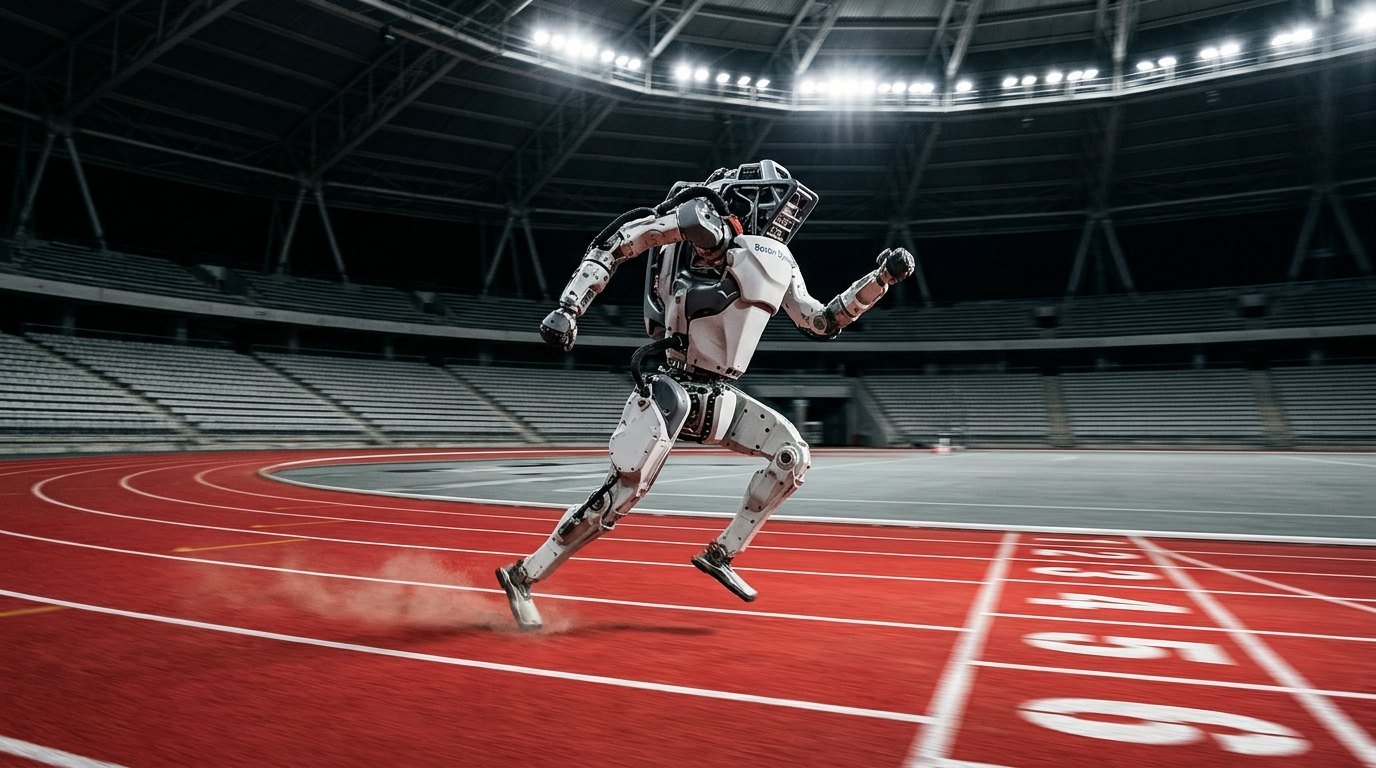
A stopwatch and a record book are not the same instrument. The Lightning robot 100m 9.32 time is real, measured and genuinely fast, and it takes nothing away from Usain Bolt. If you want to know what the machine actually proved, the gap between those two instruments is the whole answer.
Verified key facts
- Reuters: Honor's Lightning humanoid ran 100m in 9.32 seconds during a preparatory test and reached a peak speed of 14.5 metres per second.
- Reuters: In the opening 100m race at the World Humanoid Robot Games, Tiangong Ultra ran 9.39 seconds and Lightning finished second in 9.47.
- World Athletics context: Usain Bolt's 9.58-second mark from Berlin in 2009 remains the official men's 100m world record.
- UPI: The second World Humanoid Robot Games run in Beijing from 22-26 August and include sprinting, long jump, weightlifting and table tennis.
- Associated Press: More than 2,000 robots are taking part across dozens of events and practical tasks.
Can the Lightning robot 100m 9.32 run be called a world record?
Can a machine beat Usain Bolt? On a stopwatch, yes; in athletics, no. Honor's Lightning robot 100m 9.32 run was reported by Chinese state media from a preparatory test before the World Humanoid Robot Games in Beijing. Reuters confirmed the reported time and a peak speed of 14.5 metres per second. Bolt's 9.58 seconds, however, remains the men's world record because World Athletics records are performances by eligible human athletes under formal competition rules. Lightning's run is better understood as a robotics benchmark: evidence of how quickly a humanoid platform can accelerate, stabilise and cover a straight 100 metres without falling.
Why did Lightning run slower when it raced another robot?
The live race immediately showed why a laboratory-style best time and competitive performance are different. Reuters reported that Tiangong Ultra, built by the Beijing Humanoid Robot Innovation Center, won the opening heat in 9.39 seconds after overtaking Lightning near the finish. Lightning recorded 9.47 seconds. Both times were below Bolt's human record, but neither changed the athletics books. Racing introduces variables that a controlled test can minimise: start timing, lane position, balance corrections, thermal conditions and the need to avoid interference. The robots also had a conspicuous braking problem, crashing into padded barriers after the finish. Speed has advanced faster than graceful deceleration.
What does 14.5 metres per second say about humanoid engineering?
Peak speed is only one part of locomotion. A biped must place each foot accurately while its centre of mass moves rapidly above a relatively narrow support area. At 14.5 metres per second, small errors in timing or joint control can become large stability problems within fractions of a second. Engineers are balancing motor power, gear ratios, battery output, leg length, structural stiffness and control software. Lightning's result suggests that Chinese teams have pushed those systems far beyond last year's public demonstrations. The more revealing number may be repeatability: whether the robot can run close to its best time over several attempts without overheating, falling or requiring major repairs.
Why is comparing Lightning with Bolt scientifically awkward?
Human sprinting is limited by biology, not by electric motor design. Bolt had to produce force through muscles and tendons, coordinate a nervous system and obey rules governing starting blocks, reaction time, lane dimensions and anti-doping. A robot is constrained by completely different engineering choices. Its leg proportions, mass distribution and actuator output need not mimic a human body, even if the machine has a humanoid silhouette. The comparison is therefore useful for public intuition but weak as a scientific equivalence. Saying Lightning is 'faster than Bolt's record' describes elapsed time over 100 metres; saying it has broken Bolt's athletics record would confuse two incompatible categories.
What are the World Humanoid Robot Games actually testing?
The Beijing event is part sporting spectacle and part engineering stress test. UPI and Associated Press reports list sprinting, long jump, weightlifting, table tennis and other competitions alongside practical tasks. Each event exposes different weaknesses. Sprinting tests power and balance; ball games demand perception and rapid planning; lifting tests torque and grip; practical events examine manipulation. The competitive setting also forces teams to show machines outside carefully edited promotional videos. A robot that falls, misses an object or needs human retrieval reveals as much about the field as one that posts a headline-grabbing time. That transparency is valuable in an industry crowded with claims about near-term humanoid deployment.
Does a 9-second robot sprinter mean factories are about to change?
Not by itself. Industrial usefulness depends on reliability, safety, cost, battery life and the ability to perform thousands of varied motions without expert intervention. A warehouse employer may value a slower machine that can work eight hours and recover from errors over a sprinter that needs a padded wall to stop. The Games nevertheless matter because improvements in actuators, balance and control can transfer into commercial tasks. Faster walking could reduce cycle times; better recovery from instability can improve workplace safety. The 100m spectacle is a visible proxy for deeper advances, but it is not proof that general-purpose humanoids are ready for mass deployment.
What will the 22-26 August Beijing games prove beyond 9.32 seconds?
The useful evidence will come from the rest of the competition: repeated races, longer distances, manipulation events and failure rates. Lightning is entered across multiple running events, and other teams are competing with different approaches to control and hardware. If several machines sustain high speed, recover from stumbles and finish without major intervention, the field can claim a broader locomotion advance. If the headline times remain isolated demonstrations, the achievement is narrower. Bolt's 9.58 seconds still belongs to athletics; Beijing's robots are building a separate record book whose most important entries may eventually be reliability and autonomy rather than spectacle. The games are also exposing an unresolved standards problem. One team can optimise a robot for raw sprinting while another emphasises autonomous navigation, endurance or human-like motion, and the resulting times are not directly comparable unless organisers standardise dimensions, control modes and external assistance. A remotely supervised machine, a fully autonomous machine and a purpose-built racing platform may all look humanoid while solving different engineering problems. That is why Lightning's 9.32 seconds is best treated as a benchmark inside a rapidly evolving technical category. The next useful comparison is not with Bolt, but with the same robot under repeatable rules and against rival machines built to the same constraints across repeated heats and events.
Sources
- Reuters - Lightning 9.32-second preparatory test (www.internazionale.it)
- Reuters - Tiangong beats Lightning in Beijing race (www.internazionale.it)
- UPI - Lightning robot sprint (www.upi.com)
- Associated Press - World Humanoid Robot Games (apnews.com)
- Note: The 9.32-second figure was a preparatory robot test. World Athletics' human world record remains Usain Bolt's 9.58 seconds.
You may also like to read

Brazil Splits a R$2.3 Billion AI Compute Push Across Chinese and US Technology
Brazil is committing about R$2.3bn to AI compute in Rio and Rio Grande do Norte, deliberately sourcing technology across Chinese and US ecosystems.

Broadcom Is Lining Up as Much as $100 Billion for AI Chips. Who Carries the Risk?
Broadcom is discussing a vast debt package for AI infrastructure as Anthropic and other customers race to secure custom chips and data-centre capacity.

ChatGPT Can Now Read and Send Apple Messages on Macs - but the Permission Model Is the Real Story
OpenAI’s Apple Messages plugin can read, draft and send Mac messages, putting Full Disk Access and send approvals at the centre of its privacy model.

Nvidia Pays Poolside $6 Billion to License Its Model Factory and Hire 109 Engineers
The third such deal in eight months hands Nvidia a rival's core technology and staff without a purchase, and without the antitrust review a takeover draws.