Satellite images show Israel building long earthen barrier inside Gaza
Imagery reviewed by news agencies shows a berm and trench cutting across Gaza. Israel cites security; Palestinians say it entrenches division.
Commentary & Analysis ·
Verified key facts
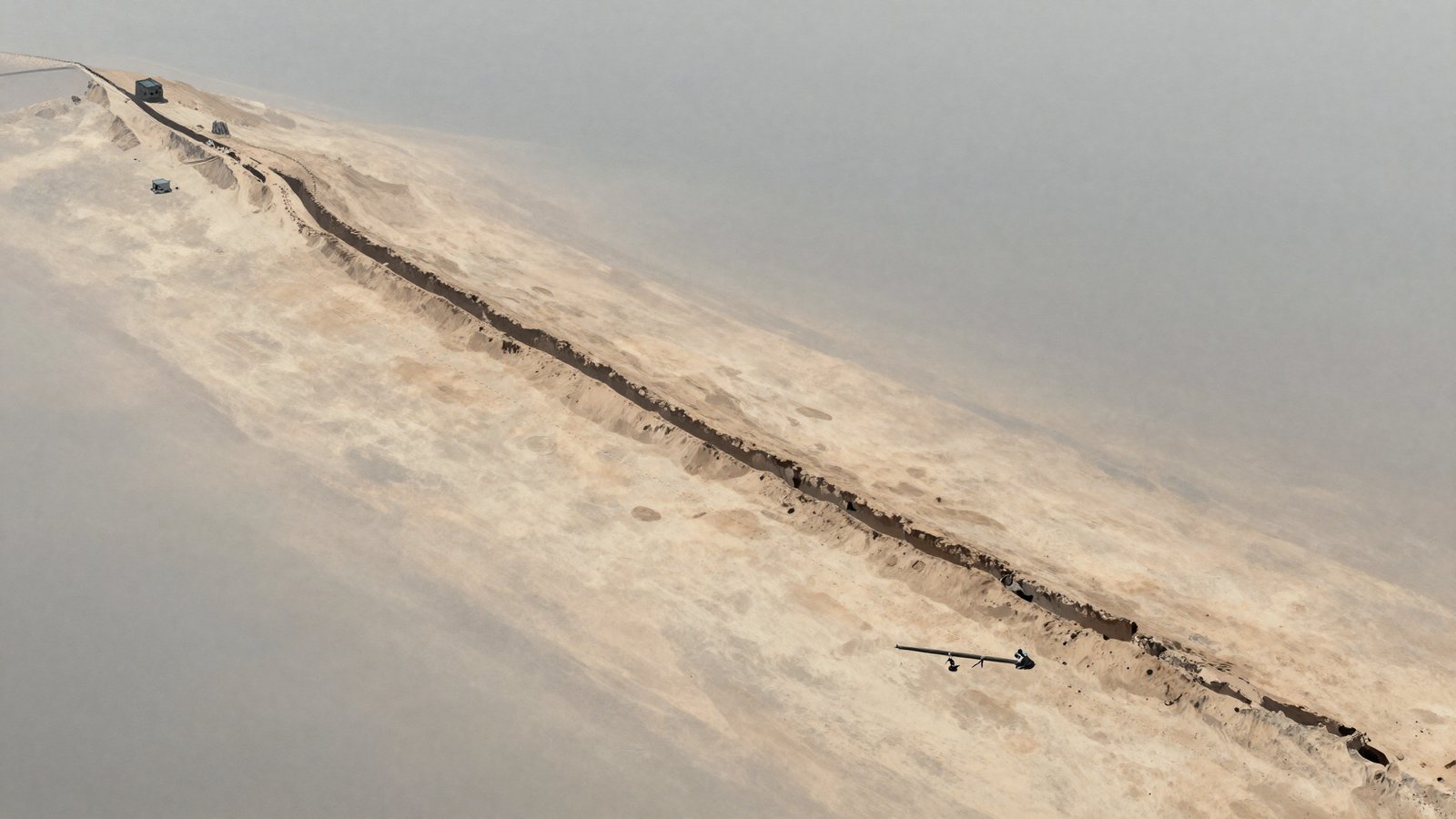
- Satellite imagery dated July 1 and 15, provided by Planet Labs and reviewed by The Associated Press and Times of Israel, shows a barrier of more than 23km inside Gaza.
- The Israeli military said the barrier is intended to prevent infiltration and protect troops and nearby Israeli communities.
- Gaza's Health Ministry reported at least 1,168 Palestinians killed since the ceasefire began; the figure cannot be independently verified.
- Reports differ on how much of Gaza is under Israeli control, with figures cited between about 60 and 70 percent.
What the imagery shows
Satellite images reviewed by The Associated Press and the Times of Israel show that Israel has built a long earthen barrier inside the Gaza Strip. According to the Times of Israel, the imagery was provided by Planet Labs and dated July 1 and July 15. The reports describe a structure made mainly of an earth berm and a trench.
The Times of Israel reported that the barrier extends more than 23 kilometres, over half the length of the coastal territory. It said the longest stretch runs almost unbroken for about 17 kilometres, from Khan Younis toward Gaza City. Additional segments were reported near Rafah and outside Beit Lahiya in the north.
The Israeli newspaper Haaretz, cited by Middle East Monitor, reported that in places the barrier appears to run beyond the so-called Yellow Line. Al Jazeera reported that near Rafah the barrier crosses that line by roughly 1,300 metres at one point, and by about 400 metres along Salah al-Din Road near Khan Younis.
What the Israeli military says
The Israeli military confirmed that it is building the barrier, according to the Times of Israel. It said the structure is intended to prevent infiltration and to protect Israeli troops and Israeli communities located near Gaza. Officials declined to specify the barrier's full intended route, the newspaper reported.
Israel has said its forces remain positioned inside Gaza pending steps under the ceasefire framework, including the disarmament of Hamas. Israeli officials have described their current deployment as a security measure while later phases of the US-brokered plan are negotiated.
The Times of Israel reported that construction accelerated through the first half of July. It said one 500-metre section grew to about 2.4 kilometres between July 1 and July 15. The military has not confirmed how long the works will take or where the barrier will end, according to the newspaper.
What Palestinians and others say
Palestinian officials and commentators have described the barrier as a step that entrenches the division of the territory. Al Jazeera reported that the structure expands the area under Israeli control and cuts through communities that have been demolished. Religion News Service, citing The Associated Press, reported similar concerns that the works deepen the enclave's partition.
Gaza's Health Ministry reported that at least 1,168 Palestinians have been killed and 3,798 injured since the ceasefire took effect, according to Al Jazeera. In a separate account this week, the ministry put the toll at about 1,200 killed. These figures are provided by the Hamas-run ministry and cannot be independently verified.
What is disputed
The share of Gaza under Israeli control is reported differently across outlets. The Times of Israel cited a figure of about 60 percent, while Al Jazeera and other reports referred to roughly 65 to 70 percent. The variation reflects differing assessments of where control begins and how the barrier is measured.
The barrier's exact path relative to the Yellow Line is also contested. Israel has not published the full planned route. Independent analysts and news agencies have relied on commercial satellite imagery to estimate where the works extend, and those estimates carry a margin of uncertainty.
- Israel says the barrier serves defensive purposes and protects nearby communities.
- Palestinian officials say it consolidates a long-term division of Gaza.
- Casualty figures come from Gaza's Health Ministry and are not independently verified.
- Control estimates range between roughly 60 and 70 percent, depending on the source.
The ceasefire framework
The Yellow Line marks the area to which Israeli forces were expected to pull back under the first phase of a US-brokered plan. That plan was set out in late 2025 and endorsed through United Nations Security Council Resolution 2803, according to the Security Council Report. It envisaged a phased Israeli withdrawal alongside the disarmament of Hamas.
Implementation has stalled. According to reporting by CNN and Al Jazeera, disputes over the sequencing of withdrawal and disarmament have kept later phases unresolved for months. Israel says it will not pull back fully until Hamas gives up its weapons. Hamas says Israel has breached the ceasefire and restricted aid.
A physical fact in a frozen process
The construction adds a physical dimension to a diplomatic impasse that has persisted since the ceasefire began. Aid agencies and UN officials have repeatedly called for unhindered humanitarian access and for the parties to advance the plan's next stages, according to United Nations meeting summaries.
Mediators, including the United States, Egypt and Qatar, continue to press both sides on the terms of withdrawal and disarmament. Whether the barrier becomes a durable line of division or a temporary security measure is likely to depend on the outcome of those talks. For now, the two sides remain far apart on where any permanent boundary should lie.
Rights groups and Palestinian officials have said they will press the case at the United Nations and in diplomatic channels. Israel has said its security needs must be addressed before any further pullback. The gap between those positions has left the physical map of Gaza in flux, even as the wider ceasefire nominally holds.
Sources
- The Times of Israel
- Al Jazeera
- Middle East Monitor (citing Haaretz)
- Religion News Service (via AP)
You may also like to read

Israel clears international stabilisation force for Gaza as disarmament dispute persists
Israel's security cabinet approved legal measures for a stabilisation force, but Hamas disarmament and aid access remain unresolved.
Hamas Disarmament Framework Sets Out a Phased Road Map for Withdrawal and New Gaza Governance
A published US-backed framework ties phased Hamas disarmament to Israeli withdrawal and an international force, but implementation and sequencing remain uncertain.

Israeli Strikes Continue in Gaza Despite Momentum Behind the Peace Plan
Israeli strikes killed Palestinians over the weekend as a disarmament framework was debated, exposing the gap between diplomacy on paper and fighting on the ground.
Israel Launches West Bank Crackdown After Deadly Clash Near Nablus
Israel began an aggressive West Bank crackdown after a deadly clash near Nablus, as settler violence spread and hundreds of Palestinians were detained.