The Multibillion-Dollar Race to Build a Way Around the Strait of Hormuz
Gulf oil producers are advancing seven pipeline projects to move crude around the world's most important chokepoint, with the UAE targeting doubled bypass capacity by mid-2027 and planners aiming to cover most pre-war export volumes by 2028.
Commentary & Analysis ·
Verified key facts
- Middle East producers are building or considering seven pipeline projects to bypass the Strait of Hormuz, with the UAE's second West-East line and Iraq's Basra-Haditha pipeline already under construction, per Kpler analysis.
- The UAE is targeting a doubling of bypass capacity to 3.6 million barrels per day by mid-2027 via a parallel ADCOP (Habshan-Fujairah) line, a roughly $3 billion, 300-kilometre project under ADNOC evaluation.
- Analysts cited by Kpler project Middle East bypass pipeline capacity could cover more than 60% of Gulf states' pre-war oil export volume by the end of 2028.
- Saudi Arabia is evaluating expansion of its East-West pipeline, while Iraq advances Mediterranean corridor options through Turkey and Syria on a three-to-five-year horizon, per Middle East Eye and CNBC.
- CNBC reporting cautions that pipelines reduce but do not eliminate the threat Iran poses to Middle East crude exports.
The chokepoint that finally moved the money
For half a century, the Strait of Hormuz has been the hypothetical that haunted every oil-market model: a 21-mile-wide passage carrying roughly a fifth of the world's crude, closable in theory by one hostile actor. The confrontation with Iran has converted that hypothetical into a line item. Gulf producers are now spending at a scale, tens of billions of dollars across pipeline and port projects by industry estimates, that treats the strait as a risk to be engineered around rather than merely insured against.
Seven bypass projects are in motion or under study across the region, according to analysis by the data firm Kpler, and the two most consequential are already under construction.
What is actually being built
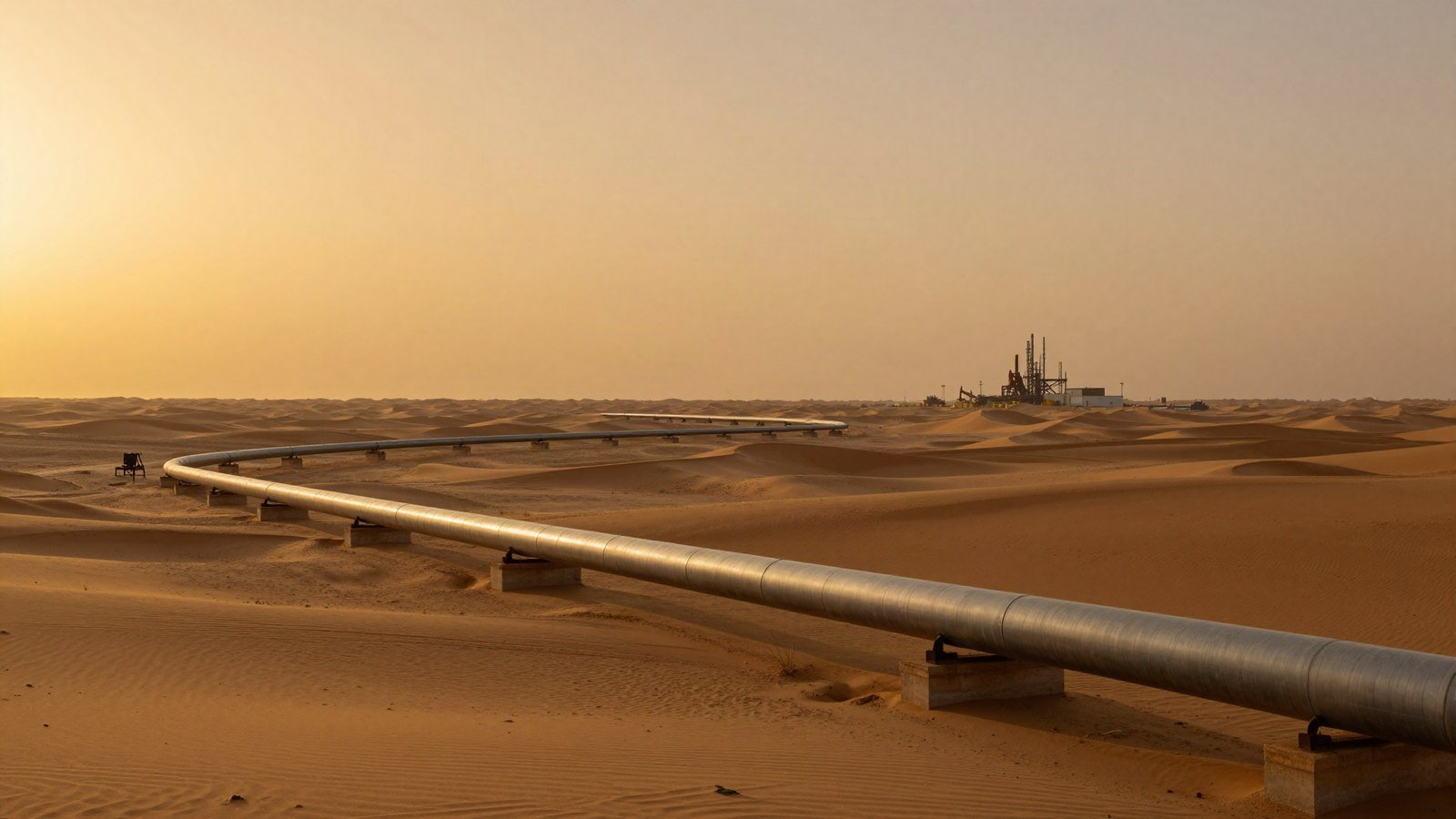
The UAE is furthest along. Its plan centres on doubling the ADCOP pipeline system that runs from Habshan's processing hub to the port of Fujairah, which sits on the Gulf of Oman, outside the strait entirely. A second, parallel 300-kilometre line, a roughly $3 billion project under evaluation by ADNOC, would lift bypass capacity to 3.6 million barrels per day by mid-2027, per Kpler and Gulf business coverage.
Iraq's Basra-Haditha pipeline, also under construction, points its crude west toward eventual Mediterranean outlets, and Baghdad is weighing corridor options through Turkey and Syria on a three-to-five-year horizon, per Middle East Eye. Saudi Arabia, which already owns the region's largest bypass in its East-West line to the Red Sea, is evaluating a further expansion.
The 60% target
The collective ambition is striking: analysts project that bypass capacity could cover more than 60% of the Gulf states' pre-war export volumes by the end of 2028. That figure would have seemed fanciful when the ADCOP line and Saudi East-West system were the only meaningful alternatives, together handling a fraction of the region's flow.
The remaining 40% is the honest measure of the strait's residual power. Qatar's LNG, Kuwait's crude and much of Iran's own trade have no plumbing around Hormuz, and no project on any drawing board changes that before the end of the decade.
Why pipelines are not immunity
CNBC's reporting on the buildout carries the necessary caution: pipelines reduce exposure to the strait, but they do not remove Iran's ability to threaten Middle East crude. Fixed infrastructure is itself targetable, as attacks on Saudi facilities demonstrated in 2019, and the loading terminals at Fujairah and on the Red Sea inherit the risk the strait sheds.
There is also the Red Sea problem: cargoes exiting via Saudi Arabia's western coast or future Mediterranean routes trade Hormuz risk for a corridor that has spent two years under intermittent attack. The bypass map, read honestly, is a portfolio of smaller risks rather than an escape from risk.
The market consequences
For oil markets, the buildout changes the shape of the fear premium. Every million barrels of credible bypass capacity shaves the tail risk of a full Hormuz closure, which is why traders track construction milestones at Fujairah as closely as naval movements in the strait itself.
For the producers, the calculus is strategic as much as commercial. Export routes that survive a closed strait strengthen their hand in any escalation scenario, reduce the leverage of Tehran's most famous threat, and, not incidentally, justify themselves as ordinary capacity expansion even if the confrontation cools.
Fujairah's quiet ascent
The emirate of Fujairah, the UAE's Indian Ocean coast outpost, is the buildout's biggest single winner. Already the region's dominant bunkering hub, its port and storage complex sits outside Hormuz by geography, and every barrel of new pipeline capacity terminates in its tank farms and loading berths.
Investment has followed: expanded crude storage, new export berths and the infrastructure that turns a bunkering station into a full-service export terminal. If the region's oil map is being redrawn, Fujairah is where the new lines converge, a strategic promotion few ports in the world have ever received this quickly.
What history says about chokepoint economics
The oil market has been schooled in chokepoint risk before, from tanker wars in the 1980s to Red Sea diversions in this decade, and each episode produced the same lesson: physical alternatives, not diplomatic assurances, are what durably compress risk premiums.
That is why this buildout differs from previous rounds of Hormuz anxiety, which produced studies and memoranda but little steel. Construction contracts, final investment decisions and completion dates are the currency of credibility, and for the first time in the strait's history, the alternatives are being built at scale simultaneously by multiple producers.
ADNOC's final investment decision
The signposts are concrete: ADNOC's final investment decision on the parallel ADCOP line, first oil through Basra-Haditha's completed sections, Saudi announcements on East-West expansion, and any progress on the Iraqi-Turkish-Syrian corridor talks.
Each milestone shifts a little more of the world's most concentrated energy risk onto new steel. The strait will remain the industry's most watched waterway, but for the first time, the money is betting on a future in which it matters less.
Sources
- Kpler - New pipelines bypassing the Strait of Hormuz
- CNBC - Pipelines won't end the threat Iran poses
- Middle East Eye - The race to bypass the Strait of Hormuz
- Axios - How oil producers are bypassing Hormuz
You may also like to read

Iberdrola Buys Control of Finland's Biggest Power Grid in EUR5bn Caruna Deal
Spain's Iberdrola agreed to buy an 80% stake in Finnish distributor Caruna for EUR2bn, valuing the grid at about EUR5bn including debt.

ECB Keeps Deposit Rate at 2.25% While It Weighs Iran War and Energy Shock
The European Central Bank left its deposit rate at 2.25% on 23 July, pausing after June's hike as an oil-price surge complicates the inflation fight.

Brent nears $86 as US blockade on Iran reignites oil rally and lifts energy giants
Brent crude climbed toward $86 after the US reimposed a naval blockade on Iranian ports, powering Shell, BP and Exxon shares and stoking $100 oil talk.
Strait of Hormuz Disruption Drives Oil Risk and a Global Naval Response
Iranian actions and threats sharply cut shipping through the world's key oil chokepoint, as the US and partners escorted vessels and sought guaranteed passage.