Taiwan intelligence says China's Pacific missile was fired from the surface, as island nations demand answers
New testimony in Taipei says China's JL-2 was launched from a surfaced platform, while Australia and Pacific leaders call the 7,300 km test destabilising.
Commentary & Analysis ·
Verified key facts
- Taiwan's deputy defence intelligence chief Hsieh Jih-sheng testified that China's JL-2 missile was fired from the ocean surface south of Guangdong, not from a submerged submarine, the Washington Times reported on 15 July.
- China launched the submarine-type ballistic missile on 6 July across roughly 7,300 km into the South Pacific, its first such test into international waters, CNN reported.
- Pacific officials said the splashdown occurred in a high-seas corridor between Nauru, Tuvalu and the Solomon Islands, inside the South Pacific Nuclear Free Zone.
- Australia's Assistant Minister for Pacific Island Affairs Nita Green said on 14 July the test was 'destabilising' for the region, Pacific news agency PINA reported.
- Palau's President Surangel Whipps Jr said the launch showed 'a lack of respect for the sovereignty of Pacific nations'.
New intelligence changes the picture
China's headline-grabbing ballistic missile shot into the South Pacific was not quite what it appeared, according to Taiwanese defence intelligence. The Washington Times reported on 15 July that the missile, identified as a JL-2, was fired from coastal waters south of Guangdong while its launch platform sat on the surface of the sea.
The testimony came from Hsieh Jih-sheng, deputy director of the intelligence office at Taiwan's defence ministry. The JL-2 is designed to be launched from a submerged submarine. A surface launch, analysts note, is a less demanding demonstration than a true underwater firing, though the political signal of the long-range flight remains potent.
A 7,300-kilometre flight across the Pacific
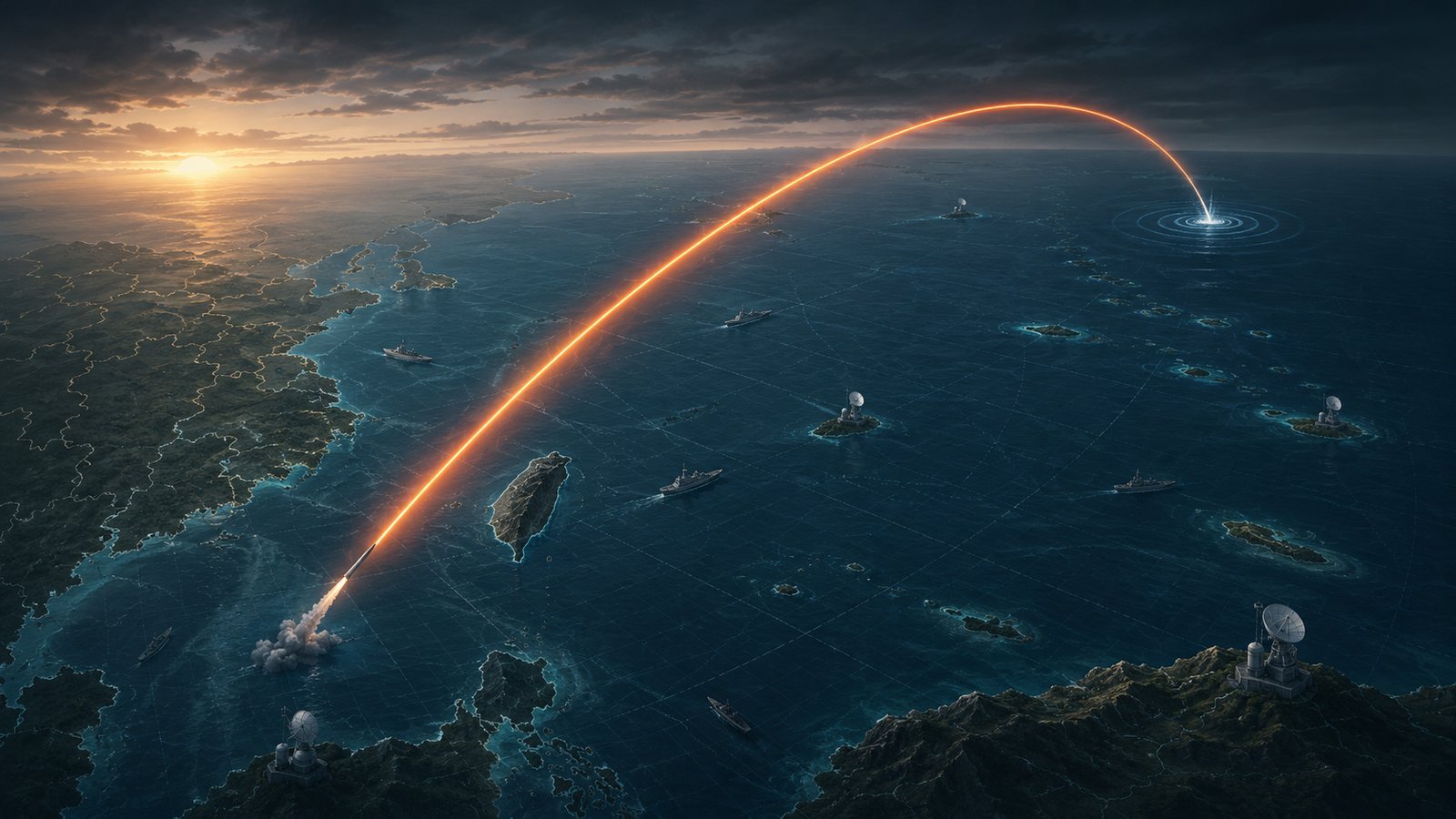
The test itself took place on 6 July. CNN reported that China fired the submarine-launched ballistic missile from the South China Sea into the Pacific, the first Chinese test of its kind into international waters. The missile carried a simulated training warhead across a flight path of roughly 7,300 kilometres and passed near Guam.
Taiwan's National Security Council had earlier identified the weapon as a JL-2 associated with a Type 094 submarine. Monitors and Pacific officials told regional media the splashdown occurred in a high-seas corridor between Nauru, Tuvalu and the Solomon Islands. That zone technically avoided national waters but sits inside the South Pacific Nuclear Free Zone established by the 1985 Treaty of Rarotonga.
Pacific capitals react with unusual bluntness
The reaction across the region has been pointed. Palau's President Surangel Whipps Jr said he was 'shocked and deeply concerned', adding that the test 'demonstrates the lack of transparency and really a lack of respect for the sovereignty of Pacific nations', Time magazine reported. New Zealand's foreign minister called the launch an 'unwelcome and concerning development'.
Australia kept up the pressure into this week. The Pacific Islands News Association reported on 14 July that Assistant Minister for Pacific Island Affairs Nita Green told regional media the Australian government was 'disappointed with the decision to test this missile in this direction'. She said Canberra wanted to 'express how destabilising this is for the Pacific region'.
Green noted that Australia's prime minister, foreign minister and defence minister all issued immediate statements. She described Pacific leaders' responses as 'very strong and indicative of what Pacific countries thought about this decision by the Chinese'. Japan's chief cabinet secretary separately criticised Beijing for expanding nuclear missile capabilities without transparency, NPR reported.
Why the launch mode matters
The distinction raised in Taipei is more than technical trivia. A submerged launch would confirm operational confidence in China's sea-based nuclear deterrent. A surface firing suggests Beijing prioritised the visible, long-range political demonstration over proving its submarines can deliver under realistic conditions.
The Center for Strategic and International Studies argued the episode underscores the need for a ballistic missile launch notification agreement with Beijing. China gave only limited advance notice, and several island governments learned details after the fact. The last comparable Chinese test into the Pacific, in September 2024, prompted similar complaints.
- 6 July: JL-2 fired from waters south of Guangdong, flight of roughly 7,300 km
- Splashdown between Nauru, Tuvalu and the Solomon Islands, inside the nuclear-free zone
- 14 July: Australia's Nita Green calls the test 'destabilising' as Pacific leaders speak out
- 15 July: Taiwan intelligence testifies the launch was from a surfaced platform, not submerged
The contest for the Pacific sharpens
The timing is awkward for Beijing's regional diplomacy. Palau is preparing to host the Pacific Islands Forum leaders' meeting, where some 2,000 delegates are expected, Islands Business reported. China has spent a decade courting island states with infrastructure and security agreements, most prominently in the Solomon Islands.
The missile's trajectory, arcing past Guam and into waters ringed by small island states, lands directly in that contested space. For Australia and New Zealand, the test reinforces arguments for deeper security integration with Pacific partners. For island governments, it revives memories of colonial-era nuclear testing that the Rarotonga treaty was written to end.
Reading China's submarine readiness
Taiwan's disclosure will feed intelligence assessments of how ready China's ballistic missile submarine fleet actually is. Regional attention now shifts to the Pacific Islands Forum, where leaders are expected to address the test collectively, and to whether Beijing offers any notification mechanism in response.
Meanwhile Taiwan's own Joint Defence Exercises run from 13 to 17 July, with live drills across the island. The two events, a Chinese missile arcing over the Pacific and Taiwanese artillery rehearsing coastal defence, capture a region preparing, publicly and simultaneously, for the possibility of worse.
Sources
- Washington Times - Taiwan intelligence says Chinese sub fired missile from surface (15 July 2026)
- PINA - Australia's Assistant Minister says China missile test was 'destabilising' as Pacific leaders speak out (14 July 2026)
- CNN - China conducts rare submarine-launched ballistic missile test, angering Pacific neighbors (6 July 2026)
- NPR - China test-launches a ballistic missile in the South Pacific and raises regional concerns (7 July 2026)
You may also like to read
China's economy grows just 4.3% in the second quarter, its weakest pace since late 2022
Official data show Chinese growth slipping below Beijing's 4.5-5% target band, as weak consumption and investment offset an export boom powered by AI demand.
China's fourth-ranked leader visits Pyongyang as Beijing works to pull North Korea closer
Wang Huning's talks with Workers' Party official Jo Yong Won follow Xi Jinping's June visit, as Beijing counters Pyongyang's deepening alignment with Russia.
Xi's Purges Have Consumed His Own Loyalists. That Is the Signal to Read.
With five of seven Central Military Commission members purged and verdicts on Zhang Youxia delayed, China's opacity is now a global risk factor.
Balochistan Insurgency Escalates With Attacks on Police, Soldiers and Transport Routes
Baloch insurgents killed abducted police and soldiers while Pakistani forces reported killing dozens of militants, in attacks and sweeps across the province.