China Sentences Evergrande Founder Hui Ka Yan to Life in Prison as Courts Close the Book on a $300 Billion Collapse
The Shenzhen court convicted the fallen property tycoon of large-scale financial fraud and fined his companies a combined $2.3 billion.
Commentary & Analysis ·
Verified key facts
- The Shenzhen Intermediate People's Court sentenced Evergrande founder Hui Ka Yan to life in prison for large-scale financial fraud, according to Bloomberg and the BBC
- Evergrande Group was fined 8.82 billion yuan ($1.85 billion) and Evergrande Real Estate Group 7 billion yuan ($1.45 billion), a combined $2.3 billion, per ABC News reporting of the verdict
- Prosecutors said revenues were overstated by roughly $80 billion across 2019 and 2020, partly by booking property sales before completion, according to ABC News
- Hui pleaded guilty in April 2026 to charges including illegal absorption of public deposits, fraud and bribery, the BBC reported
- Evergrande collapsed with more than $300 billion in liabilities after defaulting in 2021, The New York Times reported
- Several senior executives received sentences of up to 18 years, according to ABC News
A life sentence for China's most indebted developer
A Chinese court has sentenced Hui Ka Yan, the founder of the collapsed property giant Evergrande, to life in prison, drawing a judicial line under the most spectacular corporate failure in the country's modern history. The Shenzhen Intermediate People's Court convicted the tycoon of orchestrating large-scale financial fraud, according to Bloomberg and the BBC, which both reported the verdict on Wednesday.
Alongside the prison term, the court ordered Hui to forfeit all of his personal assets and stripped him of his political rights for life, the BBC reported. The sentence marks a stunning terminus for a man who was once Asia's richest, and whose company came to symbolise both the extraordinary rise of China's property market and the debt-fuelled excess that eventually brought it down.
The fraud: $80 billion in revenues that were not real
The court found that Hui and Evergrande engaged in systematic deception, inflating the group's assets and concealing its liabilities from investors, lenders and regulators. According to ABC News, prosecutors said revenues were overstated by roughly $80 billion across 2019 and 2020, in part by prematurely booking income from property sales before the homes had been completed.
Hui was also convicted of abusing his position to orchestrate the fraud and of misappropriating company assets, per the BBC's account of the judgment. He had pleaded guilty in April 2026 to a slate of charges that included the illegal absorption of public deposits, fraud and bribery, following his arrest and a long period of detention that began when regulators closed in on the company.
The scale of the deception, as described in court, dwarfs the accounting scandals that reshaped corporate law elsewhere. An $80 billion overstatement was achieved with the most mundane of tools: recognising the sale of a flat that existed only as a deposit and a promise. Auditors, ratings agencies and underwriters accepted the numbers for years.
A $2.3 billion corporate fine
The companies did not escape punishment either. Evergrande Group was fined 8.82 billion yuan, about $1.85 billion, while its main operating unit, Evergrande Real Estate Group, was fined 7 billion yuan, roughly $1.45 billion, according to ABC News. Together the penalties amount to some $2.3 billion, one of the largest corporate fines ever levied in China.
Several senior executives were convicted alongside their former chairman, receiving prison terms of as much as 18 years on charges that included illegal public deposit-taking and fraud. The verdicts suggest Beijing intends the case to stand as a warning to the wider industry rather than as the punishment of a single man.
For creditors, the fines are largely symbolic: the money flows to the state, not to the offshore bondholders whose recoveries from the liquidation are projected at cents on the dollar. The message is aimed inward, at China's surviving developers and the executives who run them.
From steel worker to Asia's richest man
Hui founded Evergrande in 1996 in the southern boomtown of Shenzhen, and rode China's urbanisation wave harder than any rival. The company pre-sold flats at enormous scale, borrowed against the proceeds, and expanded into bottled water, electric vehicles and one of China's most successful football clubs.
At the peak, Hui topped Asian rich lists and Evergrande claimed projects in hundreds of cities. The model depended on perpetual growth in prices and credit, and when Chinese authorities moved in 2020 to cap excessive borrowing by developers, the entire structure began to seize up.
The default that shook the global economy
Evergrande defaulted on its offshore debt in 2021 and collapsed owing more than $300 billion, The New York Times reported, making it the world's most indebted property developer. A Hong Kong court ordered the company's liquidation in January 2024, but most of its assets, and most of its unfinished flats, sit on the mainland beyond the easy reach of offshore creditors.
The failure rippled far beyond one balance sheet. Suppliers went unpaid, homebuyers who had put life savings into pre-sold flats were left waiting for towers that stood unfinished, and dozens of other developers followed Evergrande into default as credit dried up across the sector.
The contagion forced Beijing into a years-long management of decline, with home-completion funds, mortgage-rate cuts and state purchases of unsold stock, none of which has fully restarted the market. Property and its related industries once accounted for roughly a quarter of Chinese economic activity, and the sector's shrinkage remains the heaviest drag on the country's growth.
What the verdict means for China's property reckoning
The sentencing lands as China continues to wrestle with the aftermath of its property downturn, which has weighed on household wealth, local government finances and consumer confidence for five years. By concluding the criminal case against the crisis's most prominent figure, Beijing is signalling that accountability, at least of the personal kind, has been delivered.
Analysts quoted by Bloomberg have long noted that the deeper questions remain unresolved: how to complete the millions of pre-sold homes still unfinished nationwide, and how to compensate the retail investors and employees who bought Evergrande's wealth-management products before the collapse.
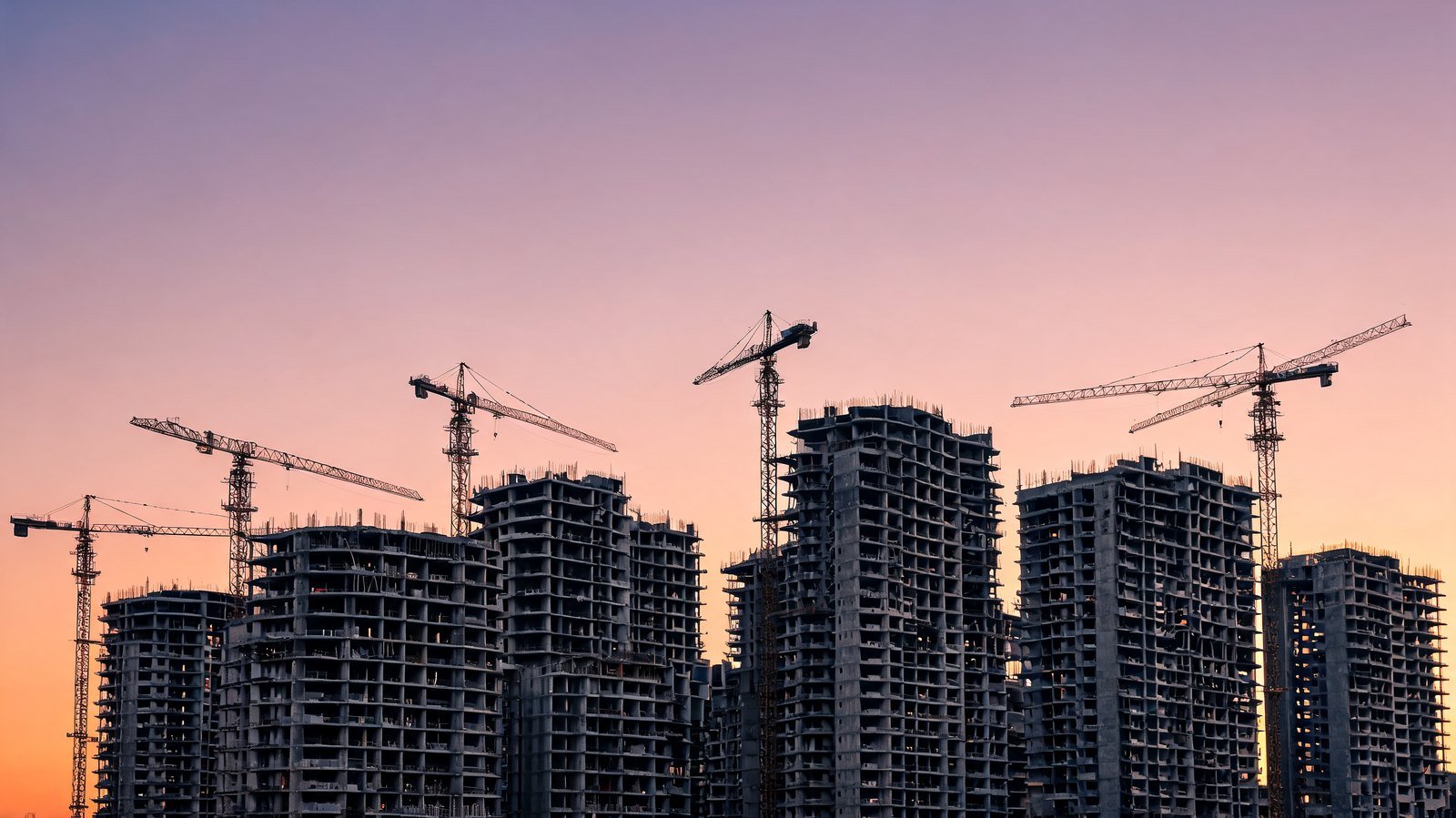
The unfinished towers Hui leaves behind
For the families still waiting on flats they paid for a half-decade ago, Wednesday's verdict changes little in practical terms. The liquidation of Evergrande's sprawling estate continues, creditor recoveries are expected to be minimal, and the fines announced by the Shenzhen court will compete with hundreds of billions of dollars in other claims.
Hui, who forfeits everything he owns and will spend the rest of his life in prison, becomes the defining cautionary tale of China's property era. The towers his company left half-built across the country will take years longer to resolve than the case against the man who ordered them.
Sources
- Bloomberg - China Sentences Evergrande Founder Hui Ka Yan to Life in Prison
- BBC - Founder of collapsed Chinese property giant Evergrande sentenced to life in prison
- ABC News - Evergrande property founder Hui Ka Yan sentenced to life in prison by Chinese court
- The New York Times - China Sentences Evergrande Founder to Life in Prison
You may also like to read

Nvidia and Wall Street Giants Form a $500 Billion AI Infrastructure Financing Alliance
The chipmaker has joined Apollo, Blackstone, BlackRock, Brookfield, Goldman Sachs and KKR in a half-trillion-dollar vehicle to fund the data centres and power that artificial intelligence now demands.
India Trade Deficit Widens to $30.43 Billion in June 2026
India's merchandise trade deficit hit $30.43 billion in June 2026, the widest since January, as imports surged 31% on costlier crude, electronics and gold.
Seoul's Kospi Sinks Nearly 6% as a Chip Rout Triggers the Sidecar and Samsung Suffers Its Worst Day in Months
South Korea's benchmark plunged as Samsung and SK hynix tumbled, with rising bond yields, oil prices and alliance anxiety all pressing on Seoul at once.
The SEC Proposes 'Regulation Crypto Assets', Its First Dedicated Crypto Rulebook, and the Industry Calls It a Win
The proposal creates a formal framework for crypto fundraising, including a startup exemption of up to $5 million, and markets rose on the news.